DOE-Funded Brain-Inspired Hardware to Enable Futuristic Robotic Systems
7/22/26Research4 min read
Duke engineers are leading a Phase 1 Genesis project funded by the Department of Energy to develop robotic AI processing hardware 10x faster and 100x more efficient than today’s top performers.
SHARE
DOE-Funded Brain-Inspired Hardware to Enable Futuristic Robotic Systems
A team of researchers led by engineers at Duke University have been awarded a Phase 1 Genesis grant from the Department of Energy to develop and integrate brain-like computer hardware that enables local, on-device robotic automation.
The research project is led by Yiran Chen, the John Cocke Distinguished Professor of Electrical and Computer Engineering at Duke; Tania Roy, associate professor of electrical and computer engineering at Duke; Shimeng Yu, the Dean’s Professor of electrical and computer engineering at Georgia Tech; and Wei Xu, senior computational scientist and Trustworthy Artificial Intelligence Group lead at Brookhaven National Laboratory.
“We are deeply grateful to the DOE for selecting us for the highly competitive Genesis program to advance neuromorphic computing hardware for the next generation of intelligent robotic systems,” said Chen, who is also the director of the NSF AI Institute for Edge Computing Leveraging Next Generation Networks (Athena).
Yiran Chen works with members of his laboratory to design and test neuromorphic computing architectures that enable faster, more efficient AI computations.
Engineering robotic systems that can see, understand language and act autonomously in fast-moving, real-world environments is extremely challenging. While progress has been made in recent years thanks to the rapid development of computer vision and large language models, current systems are far from ready for widespread deployment.
Most of the current roadblocks are due to the complexity and power consumption required by today’s state-of-the-art vision-language-action (VLA) models. They can contain up to 55 billion parameters, necessitating datacenter-class GPUs that consume up to 700 W of power—about as much as an entire mid-sized gaming computer.
The completed system will resemble a steel-born Centaur—a synthetic organism whose fundamental neuromorphic computing components and abilities form its muscles, skeleton and nervous system.
Yiran ChenJohn Cocke Distinguished Professor of Electrical and Computer Engineering
Besides the enormous amount of energy this requires when scaled to industrial levels, sending data to and from datacenters takes time and GPUs operate in bursts rather than continuously. These factors can cause latency issues that quickly devolve into catastrophic failures, especially when deployed on mobile systems.
To enable seamless automated systems at scale and on the move, the Genesis engineering team will take inspiration from the human brain, which has already solved these issues. Neuronal spikes are brief, discrete events that are both efficient and effective for processing information. Individual neuron architectures actively process much information before data is even sent to a central location. Synaptic pathways change and evolve over time to best accommodate repeated tasks.
Much of this performance can already be mimicked in manmade hardware through so-called neuromorphic computing designs that introduce an intrinsic magnetic memory component to traditional silicon architectures. Combining several emerging neuromorphic techniques into a single platform, the team will build a billion-parameter robot AI whose algorithms use spiking, event-driven fundamental processing rather than bursts of dense GPU math. In Phase I, the team is targeting a 100x energy and 10x latency reduction while maintaining task success.
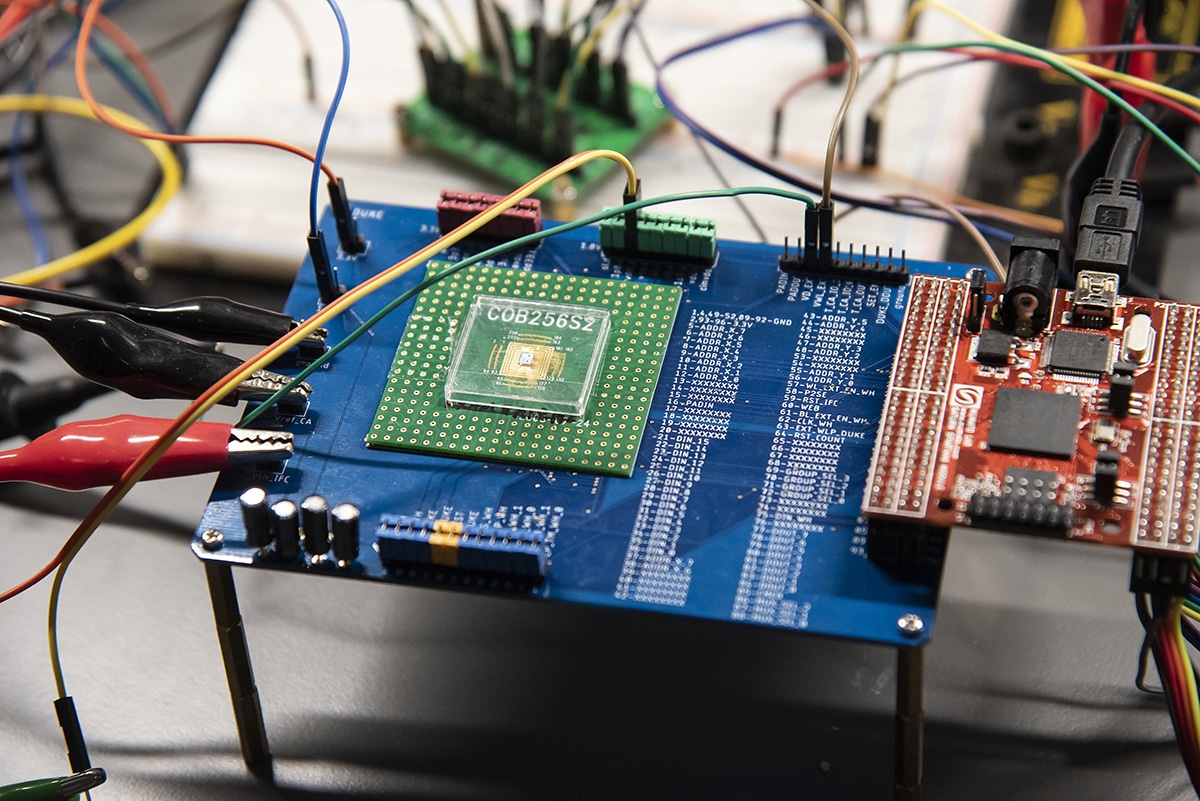
Testing the perforamnce capabilities of novel neuromorphic computing processor designs in the laboratory of Yiran Chen, whose work will anchor the Genesis Program grant to develop robotic AI processing hardware 10x faster and 100x more efficient than today’s top performers.
“The completed system will resemble a steel-born Centaur—a synthetic organism whose fundamental neuromorphic computing components and abilities form its muscles, skeleton and nervous system,” Chen said. “These computational organs are woven into a unified architecture that powers an intelligent robotic body, enabling it to perceive, reason, adapt and act with unprecedented efficiency in the physical world.”
The Genesis Mission is a historic national initiative led by the U.S. Department of Energy, which is building the world’s most powerful integrated science discovery platform. By uniting government, industry, academia and philanthropy, it is accelerating breakthroughs in energy, scientific discovery and national security through a new platform that combines AI, supercomputing, quantum systems and advanced scientific instruments.
The goal of the Phase I awards is to identify promising pathways toward transformative scientific capabilities and establish a foundation for future investment and scale. Project teams will design and demonstrate research workflows that integrate AI with scientific investigation, while rigorously evaluating whether those approaches can accelerate discovery, improve predictive capabilities, enhance experimentation or generate new scientific insights.
Phase I awards range from $500,000 to $750,000 and support projects for nine months. Phase II awards range from $6 million to $15 million over a three-year project period.
The NSF- and DHS-funded institute attracted visitors from industry and government to showcase Duke’s leadership in artificial intelligence and edge computing.
The Athena AI Institute brought together prominent stakeholders to further the global collaborations needed to scale edge AI.
Cookie Consent
This website uses cookies as well as similar tools and technologies to understand visitors' experiences. By continuing to use this website, you consent to Duke University's usage of cookies and similar technologies, in accordance with the Duke Privacy Statement.
Cookie Preferences
Manage your cookie preferences below:
Essential cookies enable basic functions and are necessary for the proper function of the website.
Name
Description
Duration
Cookie Preferences
This cookie is used to store the user's cookie consent preferences.
30 days
Google reCAPTCHA helps protect websites from spam and abuse by verifying user interactions through challenges.
Name
Description
Duration
_GRECAPTCHA
Google reCAPTCHA sets a necessary cookie (_GRECAPTCHA) when executed for the purpose of providing its risk analysis.
179 days
Google Tag Manager simplifies the management of marketing tags on your website without code changes.
Name
Description
Duration
td
Registers statistical data on users' behaviour on the website. Used for internal analytics by the website operator.