
Our Strategic Foundation
Our Purpose
We advance discovery and technologies that make a difference in people’s lives.
We focus on engineering innovation that matters, pushing boundaries in research to deliver solutions that address genuine human needs.
In the classroom, we teach students to lead with purpose, empathy, and resilience.
And beyond campus, we translate discoveries into real-world impact, bringing ideas to life in the communities we serve.
We are here because engineering, at its best, serves humanity.
Four Guiding Principles
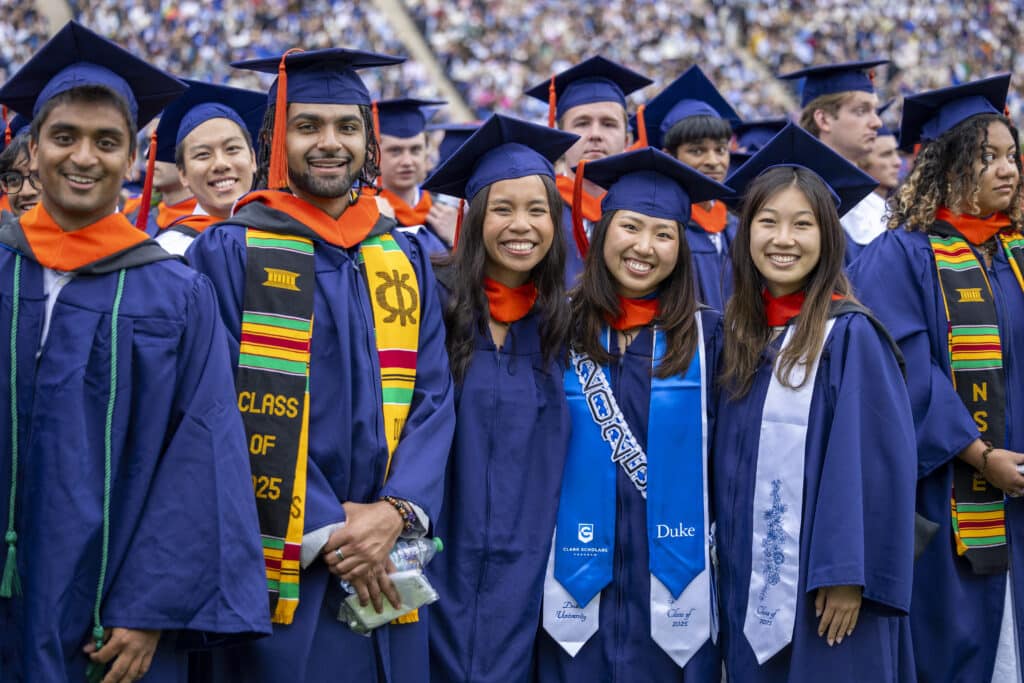
1. Think Boldly, Act with Purpose
We believe in the power of bold ideas backed by meaningful action.
We give students space to explore, experiment, and engage deeply—connecting their learning with alumni networks, industry mentors, and real-world challenges.

2. Cross Boundaries, Spark Innovation
Interdisciplinary thinking isn’t an add-on. It’s built into who we are.
Duke’s collaborative culture brings engineers together with experts in medicine, business, public policy, law, and the humanities. These partnerships lead to fresh insights and unexpected ideas, with impacts that reach well beyond campus.
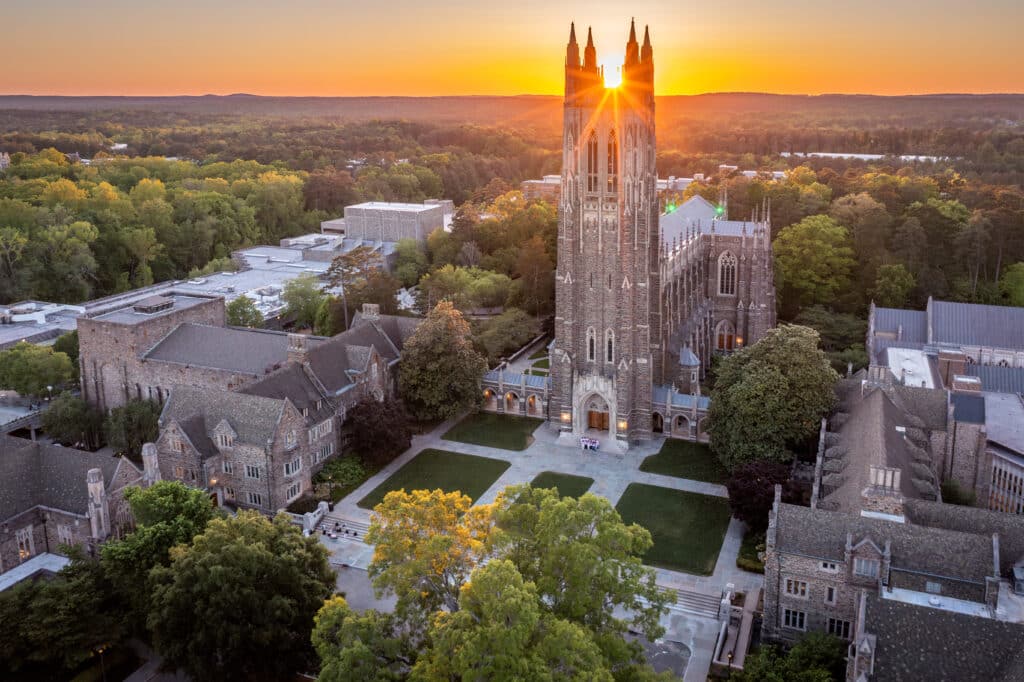
3. Engage and Amplify Impact
We know that meaningful work doesn’t happen in a vacuum.
We build trusted relationships with alumni, local communities, regional partners, and industry collaborators. By making it easier to work with us—and to listen, learn, and co-create—we extend the reach and relevance of our teaching and research.
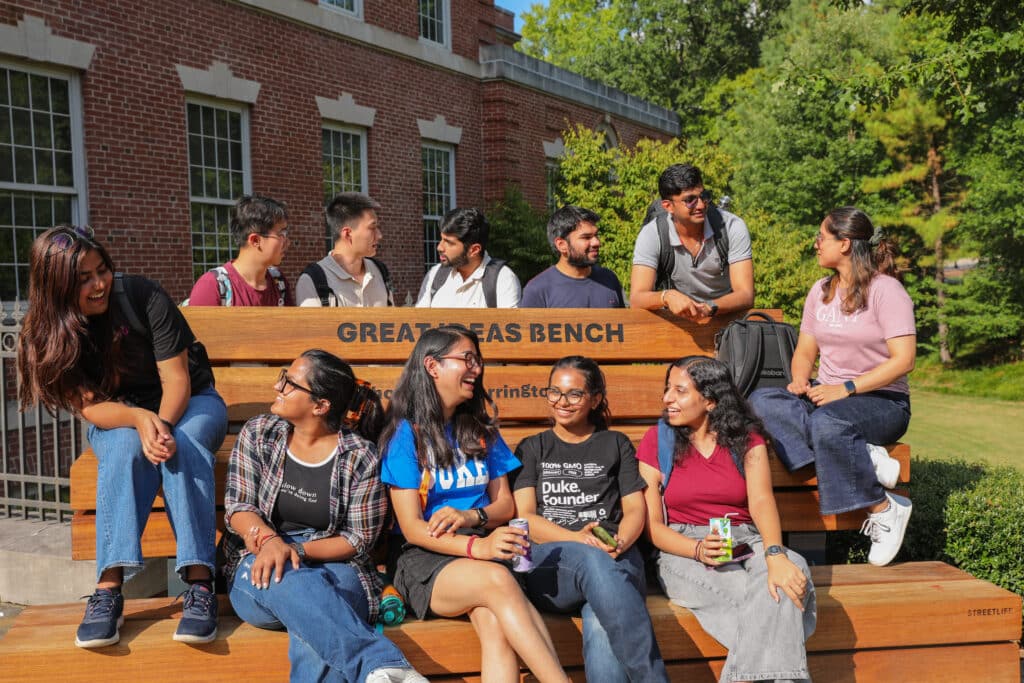
4. Create a Community Where Everyone Belongs
People thrive when they feel seen, supported, and empowered.
At Duke Engineering, we foster inclusive excellence, providing clear opportunities for growth and ensuring every voice is heard and valued.
The Evolving Landscape
There has been no better time to be an engineer than today, as we witness a rapid acceleration of astonishing discoveries across fields like quantum physics, biology, neuroscience, and climate science. These scientific advances are sure to fuel the next wave of transformative applications in engineering.
For example, deeper insights from neuroscience, such as how the human brain processes information, are unleashing new means of artificial intelligence that are certain to revolutionize many industry sectors, such as health care and finance. Another is leveraging quantum mechanics to create quantum computers that will offer exponential gains in computational power at a fraction of the energy used to power today’s silicon-based machines.
These paradigm-shifting discoveries arrive at a pivotal time. Global communities face daunting challenges—from climate disruption and environmental degradation to resource depletion and widespread health disparities—that demand creative engineering solutions that can rapidly scale. Much like when our nation rallied in the 1960s to put a person on the moon, we are now primed to pursue bold technological solutions to new challenges. A decade of public investment in science and technology took us into space with computers less powerful than a modern watch. Imagine what we can achieve today.
Given the scale and complexity of the challenges we face, the success of our solutions will not solely depend on technological performance. For collective action problems such as climate change, solutions will require financial and policy innovation as well to ensure market forces advance the good of the community. The sheer technological power behind these solutions simultaneously demands that we intentionally embed human values and social accountability into every layer of technological progress.
Yet even amid such opportunities, genuine headwinds challenge our progress. The supply of domestic talent interested in engineering remains insufficient for the growth of the nation’s engineering workforce, limiting our ability to solve the grand challenges that lie ahead. At the same time, public skepticism toward higher education and publicly funded research creates additional hurdles, threatening the sustainability of the innovation ecosystem that has long underpinned our nation’s progress. Addressing these barriers requires purposeful advocacy for stronger STEM education, increased public scientific literacy, and deeper collaborations among academia, industry, and communities.
Now is the moment for Duke Engineering to lead. We are made for this.
By leveraging our strengths in interdisciplinary collaboration, responsible innovation, and intentional societal engagement, we must not only adapt to this changing landscape but actively shape its evolution.
Our ability to rise collectively to meet these challenges will define the future of engineering—and the broader society it serves.
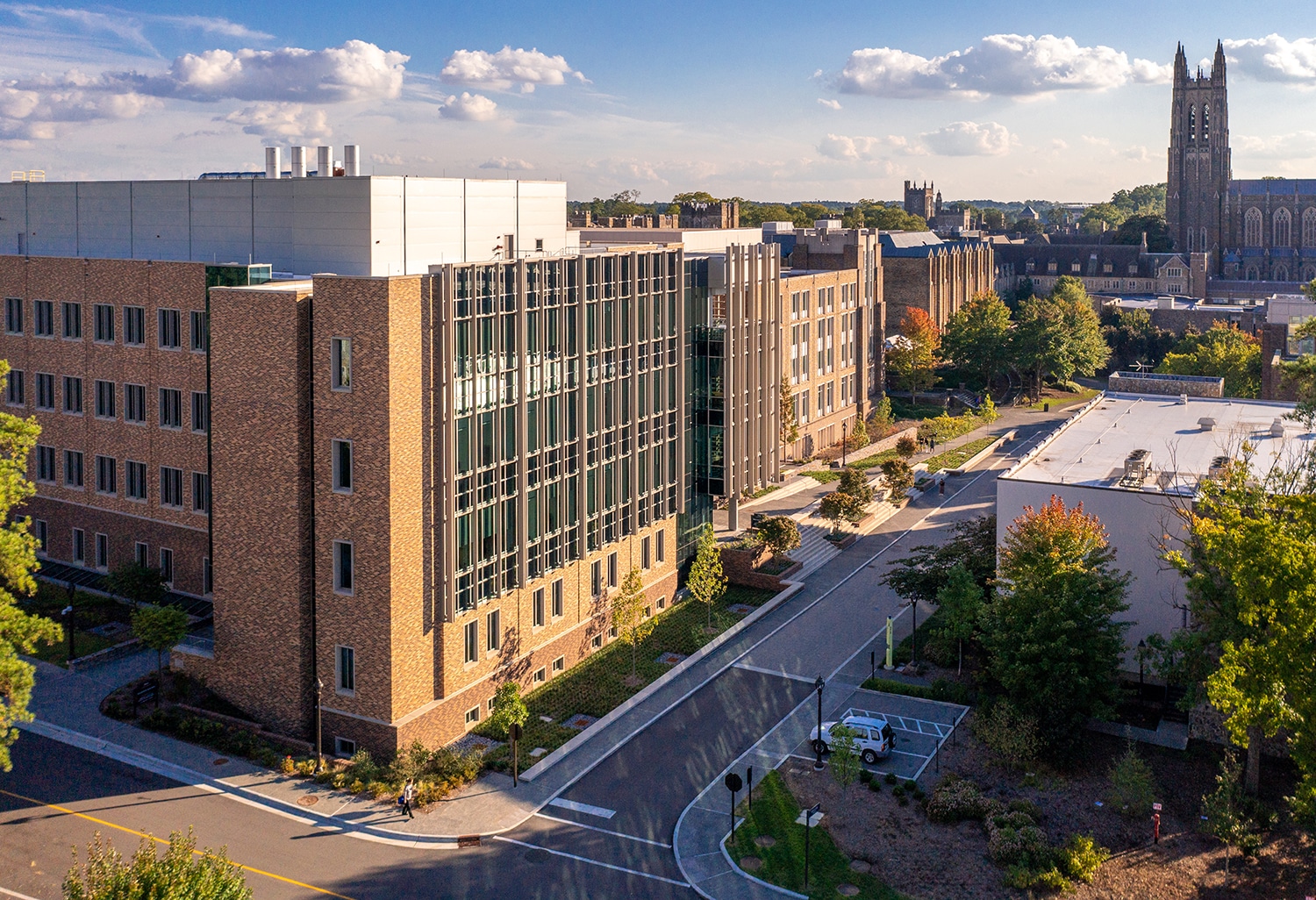
We believe technology, when paired with human talent, is among the most powerful forces for advancing the common good.
As scientific progress accelerates, engineers have ever-expanding opportunities to shape a better future. Highly disruptive technologies—such as artificial general intelligence (AGI), precision biologics, quantum computing, and even deep space technologies—are on our horizon.
At Duke Engineering, we are committed to advancing these technologies while preparing the next generation of leaders to apply them to society’s greatest challenges from climate change to national security. If engineering exists to serve society, we must ask: What kind of society will we build?
Our vision is that of engineers boldly creating an innovative, smart, healthy, and sustainable society that uplifts all people.
To deliver on that promise, engineering must strategically invest in four technological themes essential to solving the greatest societal challenges of the 21st century: computing, materials, climate, and health technologies.
Engineering programs should produce socially engaged technology leaders who can solve complex global challenges while advancing the common good. Duke Engineering has long led in design-based experiential learning, embedding real-world projects and stakeholder engagement across our curriculum. Our introduction of entrepreneurship training ensures students are not just inventors, but innovators willing to take risks and to maximize their impact.
Yet, we know that true transformation demands more. Our vision is to explicitly bring character development into the design of our curricular and co-curricular programs. Cultivating student virtues like perseverance, patience, courage, truthfulness, and integrity alongside deep technical expertise will produce the principled technology leaders of tomorrow.
We view purposeful partnerships as essential to our capacity to engineer a better society.
Beyond our long-standing collaborations with industry on research and technology translation, we must forge new alliances with K-12 educators and workforce development programs to broaden access and to produce a future engineering workforce more reflective of the communities we strive to serve.
Despite its profound benefits, we also recognize a growing skepticism toward higher education. Engineering must advocate for greater public technology literacy and engage policymakers on how technology drives social progress and solves societal problems. By partnering with local communities, our students will learn to innovate in the messiness of the real world by navigating the political, economic, and ethical dimensions of their technological solutions.
This is the engineer’s moment—and our call to action.
By fully embracing interdisciplinary collaboration, responsible innovation, and social accountability, Duke Engineering seizes the opportunity to set a new paradigm in education, research, and translation—preparing leaders to deliver the transformative solutions the world urgently needs.
Our Vision:
Engineers boldly creating an innovative, smart, healthy, and sustainable society that uplifts all people.
At Duke Engineering, the pace of progress is unmistakable. Faculty are pushing boundaries in emerging fields with the potential to reshape lives. Students are turning ideas into action—launching ventures, leading design teams, and working in communities near and far. Alumni are re-engaging with purpose, offering mentorship, opening doors, and helping us to extend our reach.
We’ve laid out a vision that reflects who we are and where we’re headed—bold in ambition, grounded in values, and ready for what’s next.
This is our time to move from vision to reality.
Not just to imagine a smarter, healthier, more just society—but to build it.
Together, we are MADE FOR THIS.
Our strategic vision comes to life through focused, measurable action. The following priorities connect this vision to the next phase: Pratt 2039. Each reflects our commitment to progress that is interdisciplinary, inclusive, and built to last.
Pratt 2039
In anticipation of our centennial in 2039, the Pratt School of Engineering conducted an aspirational visioning exercise to identify strategic priorities for the decades ahead.