

From Coursework to Patient Care: Duke Design Health Team Innovates POTS Treatment
Student-led startup pursues award-winning treatment for patients with disruptions to their autonomic body processes.
Duke Engineering spinoff company Extellis announced an oversubscribed $6.8 million round of seed funding.
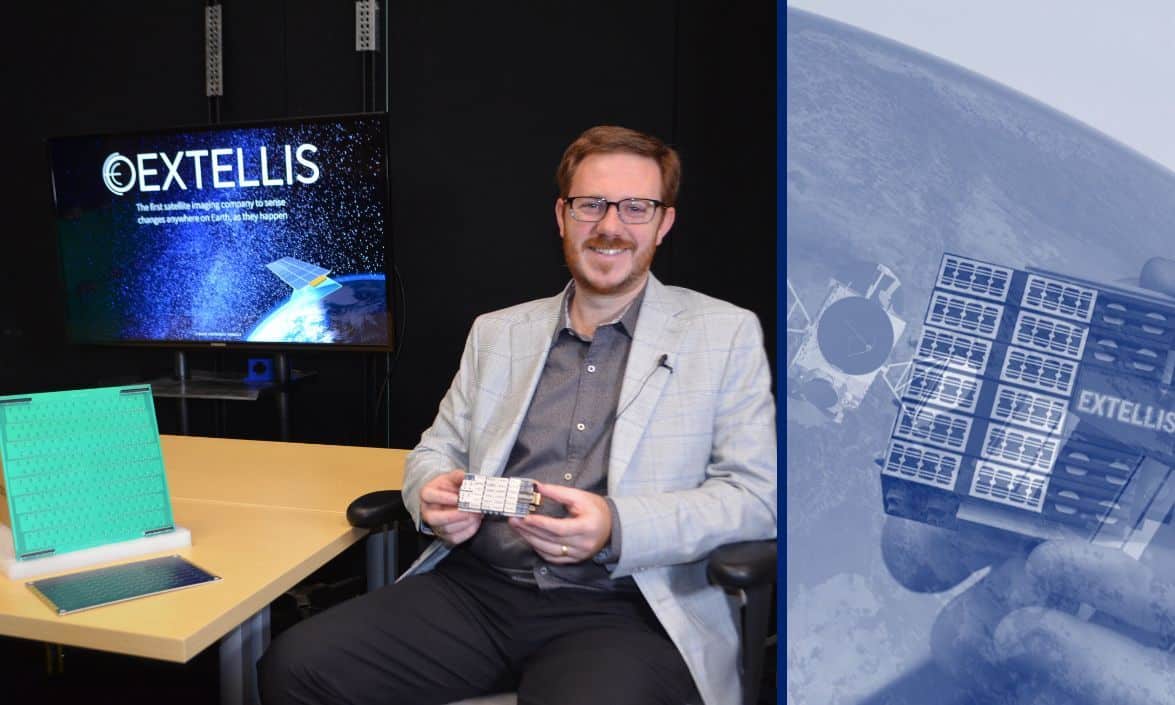
A startup company featuring Duke Engineering technology is about to give the world a much clearer view of itself.
Founded by Michael Boyarsky, a research scientist in electrical and computer engineering, Extellis is developing a new way of making satellite imaging antennas that allows them to take 100 times more images per day, delivering real-time images of the Earth within 15 minutes. The company recently announced an oversubscribed $6.8 million seed round led by Oval Park Capital that will fund Extellis’s first satellite and imagery services, in partnership with analytics and distribution providers.
“Whether you’re a general or a farmer, you can’t see what’s wrong if you can’t see what’s normal. While today’s satellites only cover a tiny fraction of Earth, ours will reliably monitor Earth at an industrial scale,” said Boyarsky. “Across energy, agriculture and other industries, customers have limited adoption of satellite monitoring due to cost and reliability concerns. As we prepare for our first orbital demonstration, we’re confident that our novel approach will retire these concerns and drive widespread adoption.”
The technology, developed in the laboratory of David Smith, the James B. Duke Distinguished Professor of Electrical and Computer Engineering, is based on metamaterials. Also enabling the world’s first “invisibility cloak” nearly two decades ago, metamaterials are synthetic materials that can exhibit properties not found in nature and have become the basis of nine different startup companies.
Founded in 2009 at Duke University, the Center for Metamaterials and Integrated Plasmonics (CMIP) consists of a group of researchers dedicated to the exploration of artificially structured materials and their potential impact across a broad range of technologies.
Student-led startup pursues award-winning treatment for patients with disruptions to their autonomic body processes.

Adam Wax received one of the top honors for academic inventors in recognition of his work to translate research in optical spectroscopy to biomedical diagnostics.
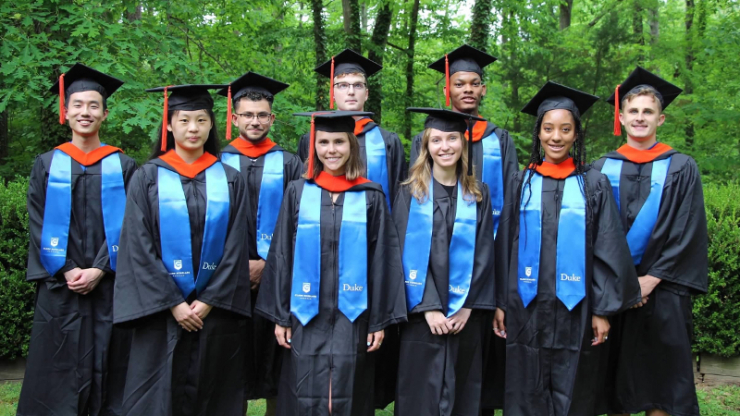
Duke University’s A. James Clark Scholars program provides full tuition and financial aid support to promising students who will develop into tomorrow’s engineering leaders.