Developing Models to Study and Engineer the Microbial World in Our Guts
Michaela Martinez
10/7/25Pratt School of Engineering6 min read
With two NIH awards totaling more than $5 million, Ophelia Venturelli will explore how the human gut can respond to internal and external influences
SHARE
Developing Models to Study and Engineer the Microbial World in Our Guts
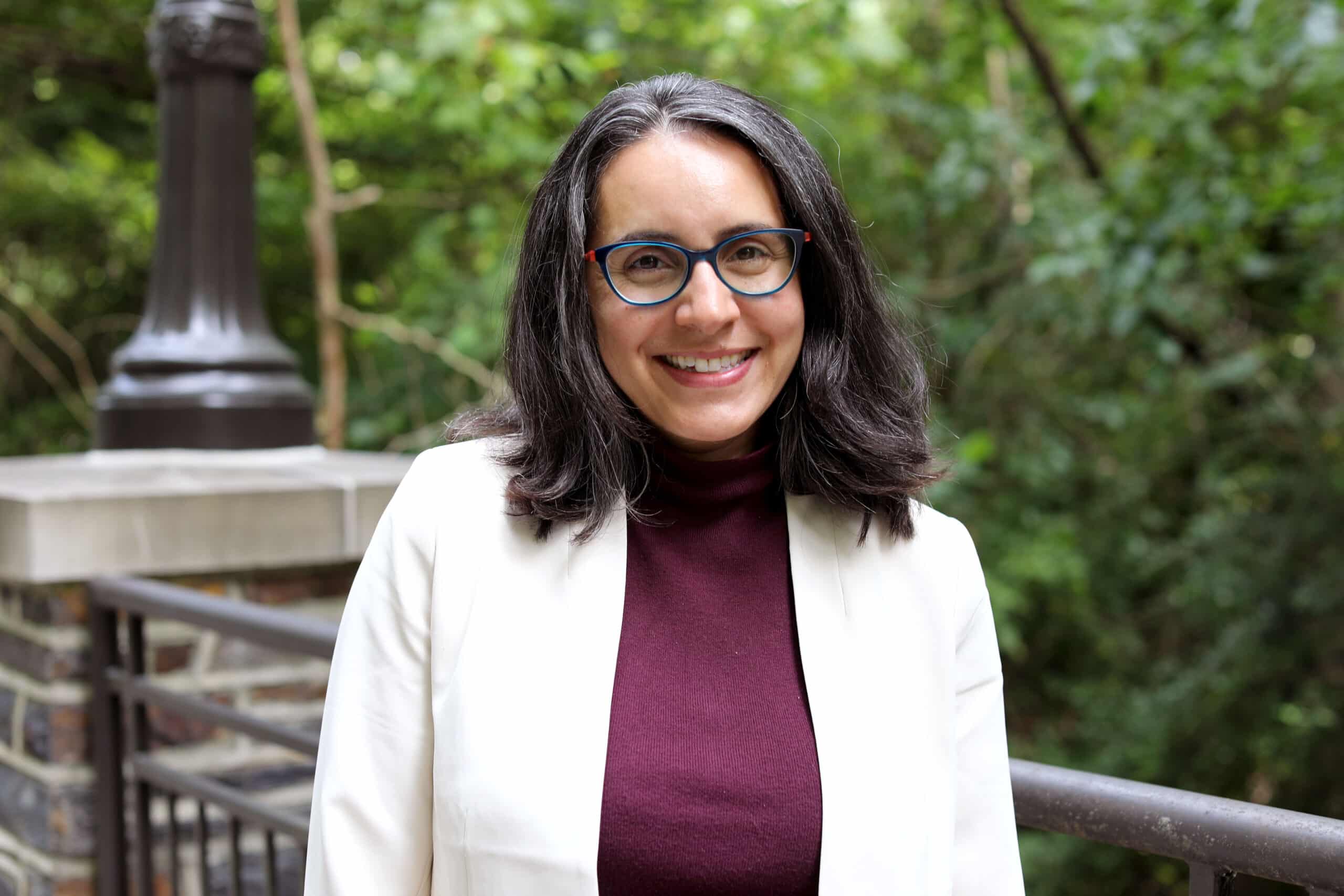
Ophelia Venturelli, an associate professor of biomedical engineering at Duke, has been awarded two NIH grants to advance microbiome research. With support from the Maximizing Investigators’ Research Award, Venturelli and her team will use computational and experimental methods to study the interactions between gut microbes and their host. A separate R01 grant from the National Institute of Allergy and Infectious Diseases will fund the team as they investigate the role of dietary fiber and probiotic inoculants in limiting the colonization of multi-drug-resistant microbes in the human gut.
The human gut is home to trillions of microbes that carry out essential tasks, from aiding digestion and regulating gut-brain communication to training the immune system and defending against harmful bacteria. While their importance to human health and behavior is well established, scientists still lack a clear, quantitative understanding of how these microbes interact with one another and how they can control these interactions to improve human health.
With the MIRA grant, which will provide more than two million in funding over five years, Venturelli and her team hope to use the computational and experimental tools that her lab developed to better understand the complex, bi-directional relationship between a host and their microbiome. The research aims to develop predictive computational modeling frameworks for host-microbiome interactions.
To accomplish this, the team will expand on computational models they previously developed with funding from an earlier MIRA grant to identify key microbial communities. They’ll use these findings to build simplified gut communities in vitro, which will then be test in human intestinal organoids and germ-free mice as models for the mammalian gut. This model will enable them to study how factors like diet, the presence of different microbial species, and the host inflammation state influence gut health, metabolism and immune response.
“Usually when we pick a media for our in vitro experiments, we only focus on using substances that can grow our cells––we don’t really think about how physiologically relevant it is,” said Venturelli. “But by integrating the ex vivo organoid and mouse models into our experimental pipeline, we can hopefully use the ex vivo and in vivo data to inform how we build these in-vitro platforms to make them more physiologically relevant.”
Usually when we pick a media for our in vitro experiments, we only focus on using substances that can grow our cells––we don’t really think about how physiologically relevant it is. But by integrating the ex vivo organoid and mouse models into our experimental pipeline, we can hopefully use the ex vivo and in vivo data to inform how we build these in-vitro platforms to make them more physiologically relevant.
Ophelia VenturelliAssociate Professor of Biomedical Engineering
Part of this work will focus on the host phenotypes such as the gut barrier, which maintains the wall between the inner contents of the intestine and the rest of the body’s internal structures. When this barrier is compromised, toxic metabolites can leak through the gut’s walls, triggering inflammation. This ‘leaky gut’ can also lead to the development of conditions like irritable bowel disorder and even colorectal cancer.
Venturelli and her team will also use the MIRA funding to study interactions between immune cells like T-cells and the microbial communities in the gut. In previous work, the lab used data driven computational models to predict how different communities in the gut would react to certain metabolites or the presence of pathogens. Now, they want to use advanced computational modeling tools to explore the mapping between gut microbial metabolites and host responses including key functions of host epithelial and immune cells. In addition, we will use clinical and in vivo data in mice to guide the design of synthetic communities and media environments.
“We aim to close a loop between high throughput in vitro, ex vivo and in vivo organismal models to improve our ability to predict and design effective microbiome interventions that can translate to complex environments such as the mammalian gut,” said Venturelli.
“We want to understand how gut microbial metabolites and pathways influence barrier integrity, and to do that we need to understand what factors affect the composition of that microbiome,” she said. “Our goal would be to eventually use this information to develop a combination of dietary interventions and a probiotics to restore the gut barrier when it is negatively impacted.”
For their second funding award, which will provide more than three million in funding over four years, Venturelli and her team will study how dietary fiber can affect the growth and persistence of multi-drug-resistant organisms (MDROs) in the human gut. These organisms pose a significant public health threat, as these bacteria can cause potentially fatal infections and easily spread in healthcare settings.
“We know that diet plays a major role on the dynamics of the human gut microbiome, and as the primary source of energy for gut bacteria, dietary fiber can promote a diverse and healthy human gut microbiome,” said Venturelli. “But we don’t have a detailed and quantitative understanding of exactly how fiber interacts with the microbiome to influence the growth and persistence of MDROs.”
To more precisely understand the role of dietary fiber, the team will collaborate with a clinical researcher Nasia Safdar at the University of Wisconsin-Madison to collect stool samples and diet data from a cohort of patients who were identified as being more susceptible to MDROs. In a partnership with Lawrence David, an associate professor of molecular genetics and microbiology and the associate director of the Duke Microbiome Center, the team will also sequence the stool samples obtained from patients to more precisely track the diets of the participants.
Venturelli will also use these stool samples to build synthetic communities to identify significant fiber-dependent interactions between constituent community members and MDROs. By building synthetic communities from the bottom-up with these isolates, the lab will explore how different types of dietary fiber can shape the interactions between MDROs and the synthetic microbiome. They’ll also test these fiber combinations in their germ-free mice to see if they can effectively decolonize these organisms from the animal’s microbiome.
“Our ultimate goal is to design a combination of dietary fibers and bacteria that could remove these MDROs from the gut, which would limit their overall transmission,” said Venturelli. “We’ve seen evidence that fiber is a useful tool for manipulating gut colonization, but we’re hopeful that this work will give us mechanistic insights and identify the specific fibers and gut microbial functions for enhancing gut health.” With support from these two NIH awards, Venturelli and her collaborators aim to transform microbiome engineering by bridging computational models with experimental data spanning multiple model systems and clinical data. By building predictive frameworks that can guide dietary, microbial, and therapeutic strategies, their work seeks to unlock new ways to protect and restore gut health.
“This work is about more than building experimental and computational models—it’s about turning our understanding of the mechanisms shaping the microbiome and interactions with the host into practical solutions that can treat or prevent multiple diseases and enhance human health,” said Venturelli.
Cookie Consent
This website uses cookies as well as similar tools and technologies to understand visitors' experiences. By continuing to use this website, you consent to Duke University's usage of cookies and similar technologies, in accordance with the Duke Privacy Statement.
Cookie Preferences
Manage your cookie preferences below:
Essential cookies enable basic functions and are necessary for the proper function of the website.
Name
Description
Duration
Cookie Preferences
This cookie is used to store the user's cookie consent preferences.
30 days
Google reCAPTCHA helps protect websites from spam and abuse by verifying user interactions through challenges.
Name
Description
Duration
_GRECAPTCHA
Google reCAPTCHA sets a necessary cookie (_GRECAPTCHA) when executed for the purpose of providing its risk analysis.
179 days
Google Tag Manager simplifies the management of marketing tags on your website without code changes.
Name
Description
Duration
td
Registers statistical data on users' behaviour on the website. Used for internal analytics by the website operator.