Kip Coonley, a faculty member of mechanical engineering and materials science (MEMS) and electrical and computer engineering (ECE), received a fellowship to create electromechanical teaching aids.
Coonley joined Duke Engineering as a staff member in 2005 to build and manage the ECE undergraduate labs as it was revamping its curriculum. Over the next two decades, he played a crucial role in the hands-on learning for thousands of Duke students.
In 2012, he started a part-time PhD focused on electromagnetic energy harvesting. After 11 years, his persistence paid off when he earned his PhD. In 2025, he joined the faculty ranks and he teaches Electrical Fundamentals of Mechatronics (EGR 224), Introduction to Microelectronic Devices and Circuits (ECE 230), and first-year computing (EGR 105L).
Last year, Coonley was named an Engineering Unleashed Fellow by the Kern Entrepreneurial Engineering Network (KEEN), recognizing his work to instill an entrepreneurial mindset in undergraduates. Through the fellowship, he worked with students to build simple teaching aids and ready-to-use teaching cards to help students visualize the mechanical concepts behind electrical circuits.
Get to know Dr. Coonley in the Q&A below.
Congratulations on being named an Engineering Unleashed Fellow. What kind of project did you pursue through the fellowship?
My project develops electromechanical teaching aids that make “invisible” electrical concepts tangible, helping students connect new ideas to what they already understand. I created models that students can touch, see and feel to better understand how things like Arduinos, transistors and diodes work.
I collaborated with colleagues across Duke—faculty who’ve already dreamed up great models in areas like biomedical engineering—and the Design POD for materials and prototyping. I also hired some undergrad teaching assistants (TAs) to develop and test models.
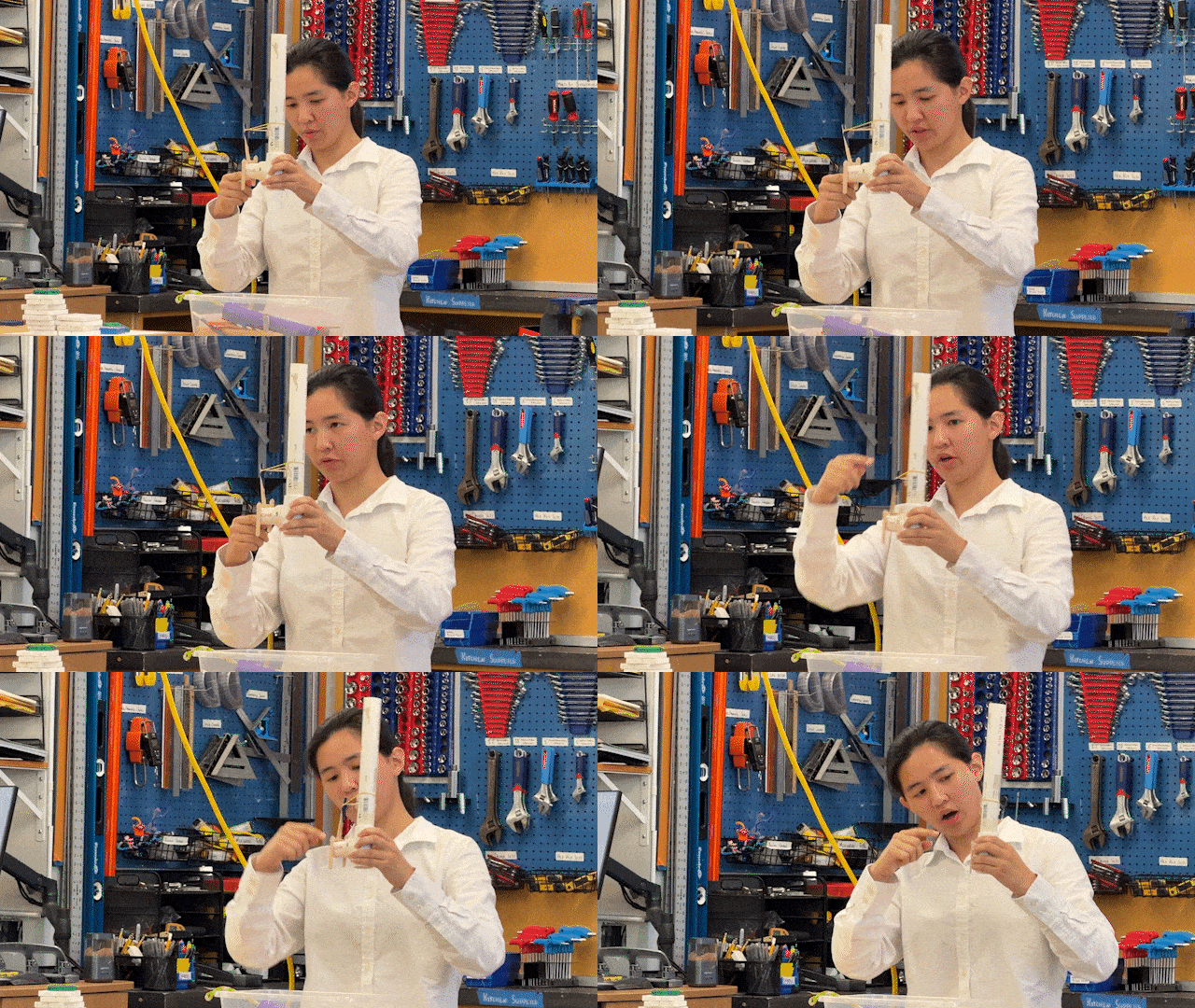
Shan Tang (MEMS Class of 2027 and one of Coonley’s TAs) demonstrates a teaching aid that explains how transistors work. The aid uses styrofoam balls that flow through a PVC pipe to mimic how electrons would move through a transistor.
Can you describe one of these teaching aids?
Think simple, low-fidelity, hands-on models plus teaching cards that any instructor can pick up, both K‑12 and college. For example, I built a mechanical op-amp model: a lever that inverts and amplifies motion with springs that mimic feedback. A tiny input becomes a big output, and feedback pulls the system back to steady state.
How do you hope the teaching aids will help your students?
The best engineers I’ve ever seen can intuit how a circuit will work before it’s built. They just know if this lever’s pulled, then this will move, and then that will move, etc., and that’s what I’m hoping to instill in our students.
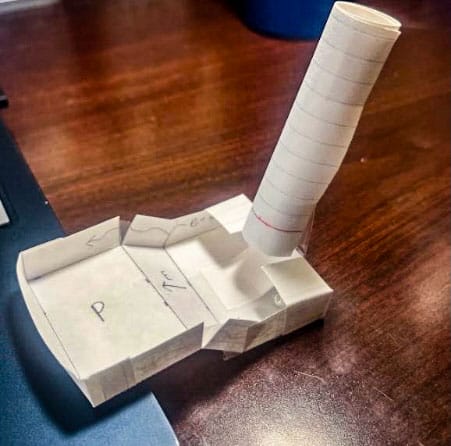
A teaching aid made out of a cut & folded index card that teaches students how PN junction diodes work. Students can build the cutout and place balls in it to learn how electrons and holes move in semiconductor devices.
We’re just the right size to have some real experts but also remain accessible.
Kip CoonleyAssistant Professor of the Practice of MEMS and ECE
What research did you do for your PhD?
I began research with ECE professor Matt Reynolds in the area of wireless radio frequency energy harvesting, which stores the energy from the movement of small waves over many cycles. When he left Duke, I then moved to the lab of Dr. Brian Mann to study mechanical systems that convert motion to electricity using electrostatic plates. I also worked closely with Dr. Martin Brooke as well as Dr. Steve Cummer, Dr. Angel Peterchev, Dr. Doug Nowacek, and Dr. Neal Simmons who were on my thesis committee.
What was it like doing a PhD part time?
I guess there’s a stick-to-itiveness in my nature. I’m glad I did it. There were obviously time management challenges with my job and being a dad to four kids. There was also the challenge of picking a research topic that wouldn’t go out of date after 11 years. There’s not really a template in the graduate school for part-time PhDs, and after eight years, I started hearing from them regularly to see where I was in my research (laughs).
What’s it been like to transition from staff to faculty?
There’s a different dynamic. I feel a lot more siloed because I’m only teaching a few courses and seeing slices of the student population. When I managed the labs, I saw the whole breadth of ECE over multiple years. Now I get to know fewer students better—more depth and less breadth. There are pros and cons.
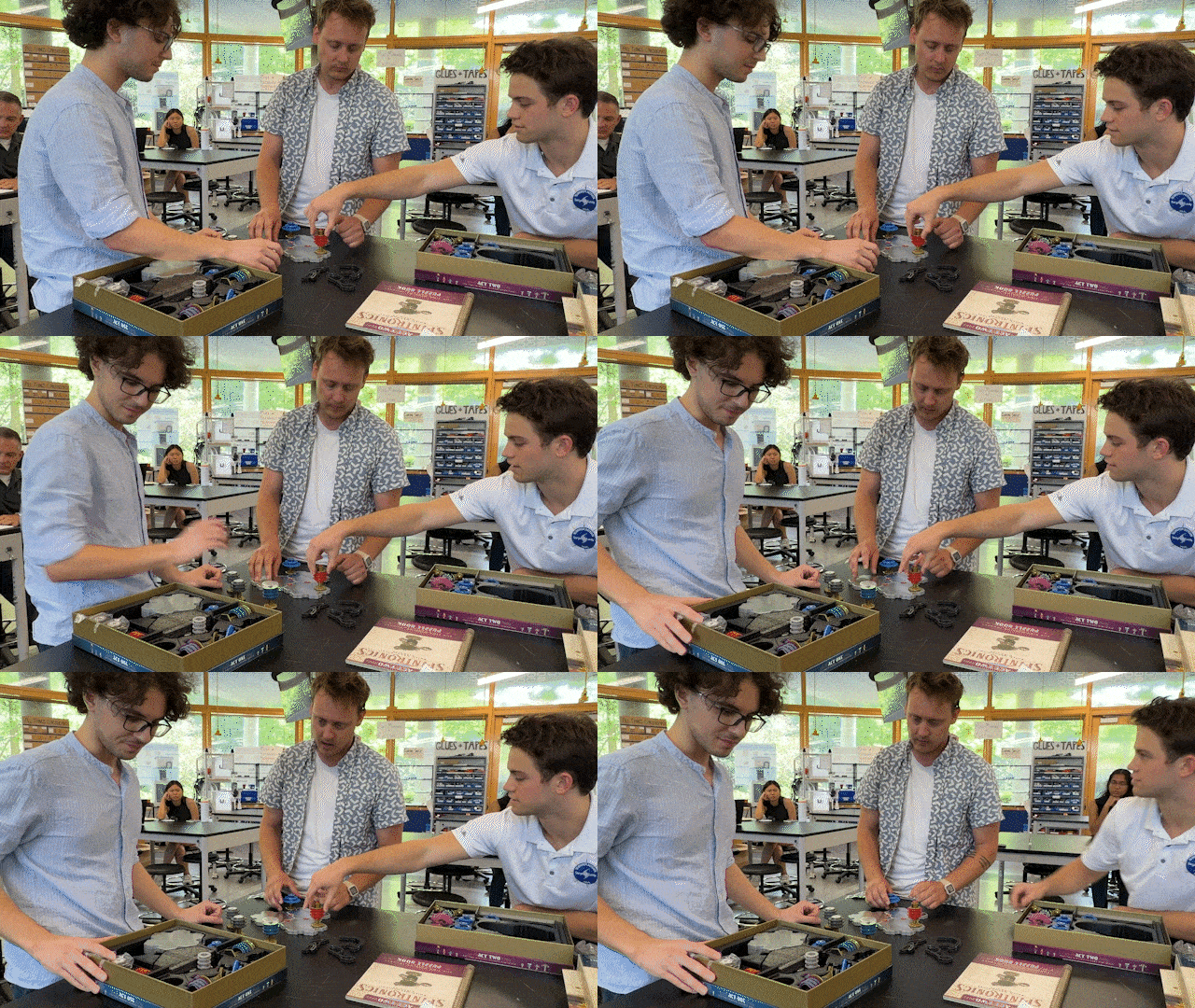
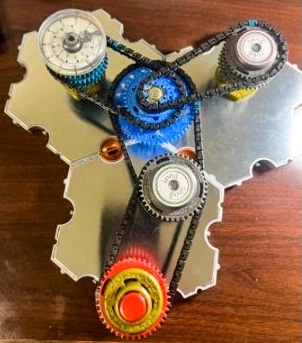
Bryce Bowman (ECE Class of 2027 and one of Coonley’s TAs) demonstrates a teaching aid that explains how a low-pass filter works by challenging participants to build a model with a Spintronics gear toy kit. An example of a Spintronics kit build that demonstrates the principle behind a low-pass filter.
What do you enjoy most about working at Duke?
The access and collaboration. We’re just the right size to have some real experts but also remain accessible. I also like that Duke is a liberal arts school, so our students get exposed to many subjects and ideas.
How can students or faculty get involved with your fellowship project?
Right now, our focus is on implementing and refining the existing teaching aids & activities while expanding the collection of modules for use in both classroom and lab settings. These materials & modules will also be made available online for broader access. Ultimately, the goal is sustainability: creating teaching aids, lab activities, and outreach experiences that others can adopt, adapt, and build upon.
Reach out if you want to co-develop or pilot a teaching card or model in your course. I’m especially interested in cross-disciplinary ideas and student designers who want to help build the next set of prototypes.
From 3D printed braces used by the NFL to a gel that can help regrow bones, all kinds of innovations are coming out of a Duke incubator called the BRiDGE.
Duke’s MEng in Game Design, Development, and Innovation program connected with an alumnus to use a quirky, yellow, handheld game console to teach iterative design.
Nimmi Ramanujam and colleagues are bringing AI‑powered cervical imaging to clinics in Kenya and rethink how diagnosis could work everywhere.
Cookie Consent
This website uses cookies as well as similar tools and technologies to understand visitors' experiences. By continuing to use this website, you consent to Duke University's usage of cookies and similar technologies, in accordance with the Duke Privacy Statement.
Cookie Preferences
Manage your cookie preferences below:
Essential cookies enable basic functions and are necessary for the proper function of the website.
Name
Description
Duration
Cookie Preferences
This cookie is used to store the user's cookie consent preferences.
30 days
Google reCAPTCHA helps protect websites from spam and abuse by verifying user interactions through challenges.
Name
Description
Duration
_GRECAPTCHA
Google reCAPTCHA sets a necessary cookie (_GRECAPTCHA) when executed for the purpose of providing its risk analysis.
179 days
Google Tag Manager simplifies the management of marketing tags on your website without code changes.
Name
Description
Duration
td
Registers statistical data on users' behaviour on the website. Used for internal analytics by the website operator.