John Hickey Receives V Foundation Scholar Award to Improve T Cell Cancer Therapies
Michaela Martinez
12/9/25Pratt School of Engineering
The award will fuel Hickey’s efforts to reveal how T cells can better infiltrate and attack solid tumors
SHARE
John Hickey Receives V Foundation Scholar Award to Improve T Cell Cancer Therapies
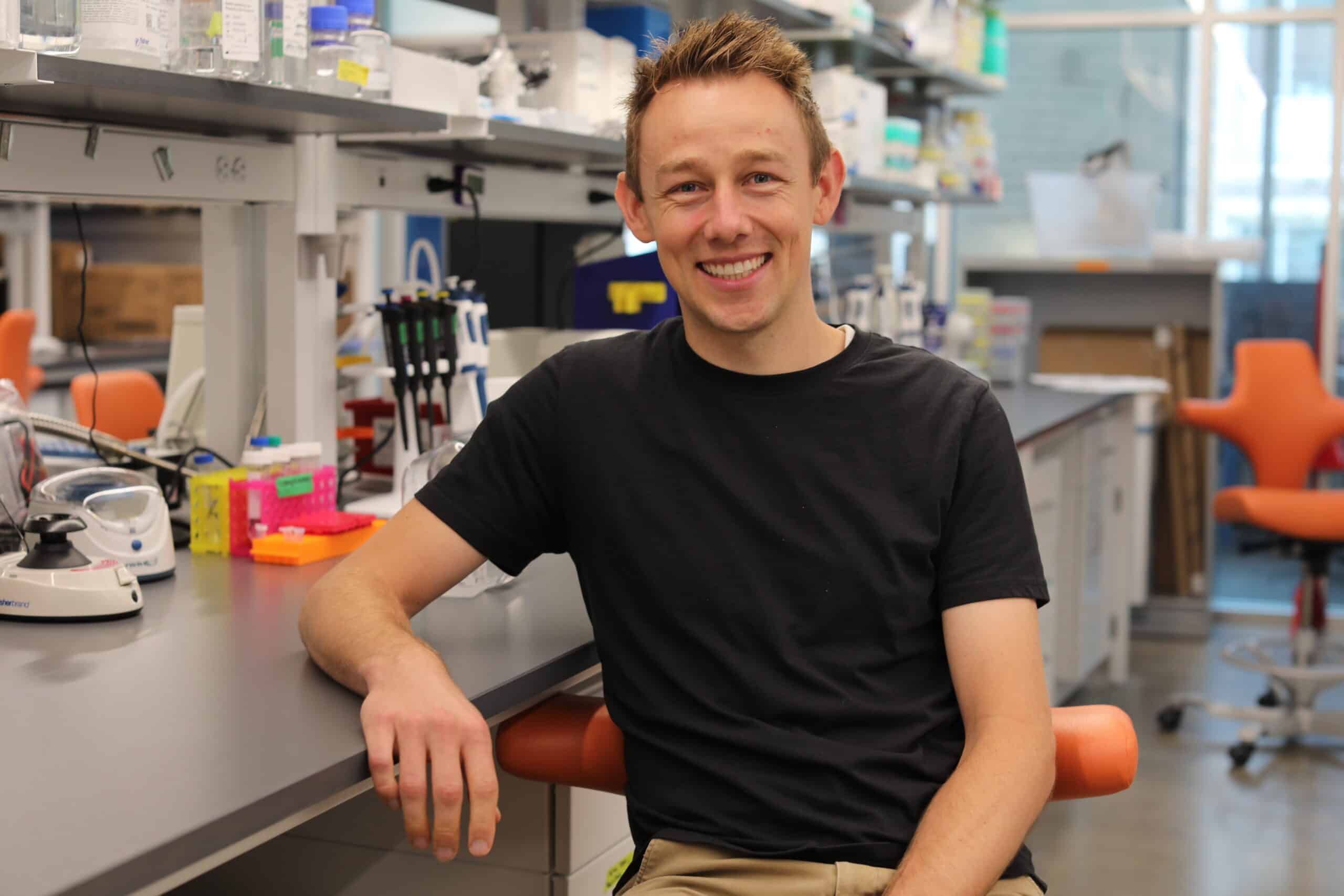
John Hickey, an assistant professor of biomedical engineering at Duke University, was awarded a V Foundation Scholar Award to improve the use of T cell therapies to treat cancerous tumors.
The V Foundation for Cancer Research was founded in 1993 by Jim Valvano, the basketball coach for North Carolina State University, and ESPN. Since its creation, the foundation has funded nearly $500 million in cutting-edge cancer research for all types of cancers.
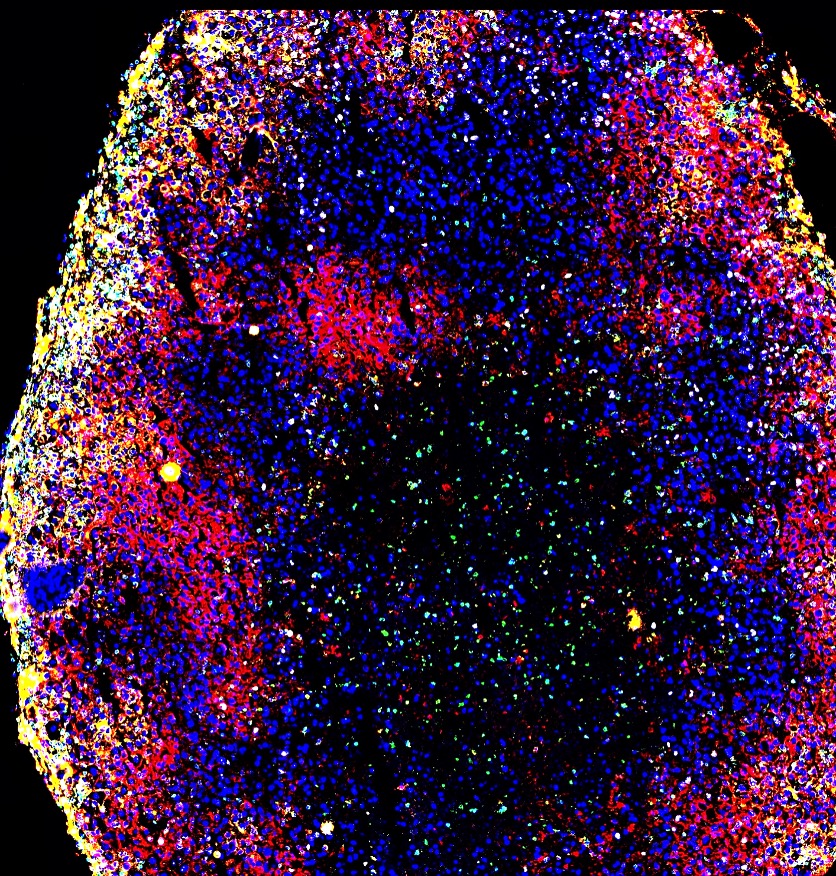
Hickey’s lab explores how cells respond to their environment in both healthy and diseased states. This work relies on a technique known as multiplex imaging, which tags various types of proteins with differently colored markers to view the activity of dozens of proteins at once. Because different cell types will express different surface proteins, Hickey and his team can create colorful images of cells and tissues that relate to their state and function.
His lab will use this imaging approach to better understand how targeted biochemical and biophysical stimulation can help direct T cells to more precisely infiltrate and attack solid cancerous tumors.
“T cell therapies have historically worked well in liquid cancers like blood cancer because they’re able to go directly to where the cancer is when you inject it,” said Hickey. “But for solid cancers like pancreatic cancer, colorectal cancer, lung cancer or anything else that affects a solid organ, the T cells have to exit the blood stream, find the tumor and then get through additional barriers to kill it, and that presents a number of challenges that limit efficacy.”
T cell therapies have historically worked well in liquid cancers like blood cancer because they’re able to go directly to where the cancer is when you inject it. But for solid cancers like pancreatic cancer, colorectal cancer, lung cancer or anything else that affects a solid organ, the T cells have to exit the blood stream, find the tumor and then get through additional barriers to kill it, and that presents a number of challenges that limit efficacy.
John HickeyAssistant Professor of Biomedical Engineering
Solid tumors are able to send out signals that suppress the immune response in their local environment. Researchers have long been looking for ways to help T cells better infiltrate these areas, but thus far traditional T cell therapies have had limited effect. But Hickey is optimistic that his team’s approach could make these therapies more successful.
Using his labs imaging and mapping tools, Hickey’s team aims to study how different T cell stimulation approaches can help alter T cell development and behavior. First, the team will use biomaterials to create artificial cells that mimic the functions of natural cells. These artificial cells will be coated with different proteins before being added to a culture alongside standardized T cells. They’ll then use microscopy to study how hundreds of different stimulation approaches alter T cell growth and behavior in cell cultures.
The research team will then use machine learning and their multiplexed imaging tools to identify the different types of T cells that developed and their respective behaviors. They’ll also explore whether this T cell behavior is influenced by factors like a patient’s age, sex or disease history.
Once these different stimulation guidelines are established, Hickey and his team will test how the T cells behave in solid tumor models. Ultimately, Hickey hopes this work will illuminate what T cell characteristics are the most effective at destroying solid tumor cells.
The competitive, three-year grant will provide Hickey and his team with nearly $600,000 in funding as they accomplish this work.
“I am incredibly grateful to have received this award to accomplish this work, which has the potential to transform how T cell therapies are designed, manufactured and deployed,” said Hickey. “We hope our approach can provide a blueprint for researchers to rationally engineer next-generation T cell therapies that are tailored to treat different solid tumors and individual patients.”
Cookie Consent
We use cookies to improve your experience on our site. By using our site, you consent to cookies.
Cookie Preferences
Manage your cookie preferences below:
Essential cookies enable basic functions and are necessary for the proper function of the website.
Name
Description
Duration
Cookie Preferences
This cookie is used to store the user's cookie consent preferences.
30 days
Google reCAPTCHA helps protect websites from spam and abuse by verifying user interactions through challenges.
Name
Description
Duration
_GRECAPTCHA
Google reCAPTCHA sets a necessary cookie (_GRECAPTCHA) when executed for the purpose of providing its risk analysis.
179 days
Google Tag Manager simplifies the management of marketing tags on your website without code changes.
Name
Description
Duration
td
Registers statistical data on users' behaviour on the website. Used for internal analytics by the website operator.