From Labs to Libraries: Tales of Duke Engineering Summer Outreach
Maddie Go
10/31/25Pratt School of Engineering
MEMS faculty, staff, and students spent the summer mentoring young researchers, engaging middle schoolers in STEM, and bringing robotics to life for kids in the Durham community.
SHARE
From Labs to Libraries: Tales of Duke Engineering Summer Outreach
Even when undergraduate classes are out of session, Duke’s campus buzzes with activity over the summer. From laboratories to libraries, there are Duke Engineering faculty, staff and students that spend the summer making an impact on the wider community around them. Check out three outreach efforts led by members of the Thomas Lord Department of Mechanical Engineering and Materials Sciences (MEMS) over the summer.
Undergrads in the Labs
A new joint initiative between Duke Engineering and North Carolina Central University (NCCU) paired NCCU students with Duke labs to conduct their own research over nine weeks this summer. Because NCCU doesn’t have an engineering school, this program is perfect for its students who are interested in exploring a career in engineering.
The inaugural Pratt-NCCU cohort has lunch in The Commons with program director Carmen Rawls (far left).
In addition to providing technical research experience, the Pratt-NCCU program builds a community. From on-campus lunches to trivia nights with students from other summer programs, the scholars grew closer with their peers as they bonded over their shared experiences — both in and outside the lab.
“One conversation the students and I had early on was about how their experiments were not going right on the first try,” said Carmen Rawls, the Duke-NCCU program director and assistant dean for advising & outreach at Duke Engineering. “But it’s different hearing this advice from a mentor figure versus commiserating with friends. By talking with other students, the scholars learned that they were all going through the same thing. They realized that setbacks are a natural part of research.”
Rawls and the Pratt-NCCU scholars at the Duke Summer Research Showcase. From left to right: Jayvon Butler, Ali Gulzar, Monique Armelle Dacanay, and Zaid Abdeen.
Jayvon Butler, an NCCU senior studying physics with an engineering concentration, spent the summer in the lab of MEMS professor and chair Christine Payne, studying nanoparticles that can be used in biomedical applications like drug delivery and diagnostics.
“The Pratt-NCCU program tested my adaptability and highlighted my ability to work hard toward a goal,” Butler said. “This experience not only broadened my technical skill set but also helped me grow in a professional research environment. I am truly grateful for the mentorship and support I received on this journey.”
Butler runs lab tests to analyze the nanoparticles he uses in his research.Butler’s lab bench where he works with nanoparticles and proteins.Butler presents his poster at the Duke Summer Research Showcase.Javyon Butler, one of the inaugural Pratt-NCCU scholars, conducted research on nanoparticles while working in MEMS professor Christine Payne’s lab this summer.
Rawls hopes that next summer, the program will grow in popularity thanks to the positive experiences of the first cohort.
“Programs like these are important because they provide undergraduates with a unique glimpse of what life as an engineer could be like,” Rawls said. “Building these connections between schools could also open doors for future collaborations as these students apply to grad school or otherwise decide what their next step will be.”
Middle Schoolers in Math Camp
Combining math and summer is not most people’s idea of fun. But what if you could learn math via paper crafts or sliced bagels?
GEM students working with origami paper crafts as part of a math activity.
Girls Exploring Math (GEM) is a summer workshop series that engages middle schoolers with math in more interactive ways than usually possible in a standard classroom setting. The two-week program is open to all rising seventh- to ninth-graders in Durham Public Schools (DPS) regardless of gender and welcomes all levels of interest — from enthusiastic mathletes to those uncertain or even fearful of the subject.
This summer, the program began each morning with a hands-on puzzle related to a specific math concept. Cutting out repeating paper patterns introduced the students to fractals; uncovering the magic behind card tricks turned out to be a lesson in bases; and learning to slice a bagel so that it had one continuous side taught the kids about mobius strips and topology.
“We want to show students that math can be fun,” said Sophia Santillan, one of the GEM team directors and a MEMS associate professor of the practice. “You don’t always have to do things in a formulaic way: you can build creative solutions.”
Tori Akin (far left, standing) explains a card trick puzzle to the GEM students.Sophia Santillan (left) discusses a math problem with some of the students.
Another GEM team director, Tori Akin, is an associate professor of the practice of mathematics at Duke. She has an infectious enthusiasm for the subject, which came in handy whenever she led puzzle-solving sessions because the students couldn’t help but get excited alongside her.
“If I can get even one kid interested enough to think, ‘Wait, why does this work? Can we go one step further?’ Then I’ve achieved my goal,” said Akin.
After the puzzle-solving sessions, the students had the opportunity to visit the labs of different scientists, engineers and clinicians at Duke, and ask the STEM professionals about their work, life and interests.
Astrophysicist Dr. Eve Vavagiakis explains how she uses telescopes to study the nature and origin of the universe.GEM students visit the lab of cell biologist Dr. Chantell Evans and learn about neuronal mitochondria.Cardiologist Dr. Jessica Reganexplains how she treats patients and conducts research on heart disease.Neurologist Dr. Suma Shah talks to GEM students about immunotherapy clinical trials.The GEM students visited the labs of several STEM professionals at Duke.
“We know from social science research that there’s a stereotype of STEM jobs being solitary jobs where you can’t help other people, and this can drive students away from pursuing those paths,” said Lauren Valentino, the third GEM team director and an assistant professor of sociology at the University of North Carolina at Chapel Hill. “But in so many of the labs we visit, we see STEM professionals collaborating in teams and trying to make the world a better place. This helps to change the students’ perspectives early on of what it means to work in STEM.”
The GEM program has received great feedback from participants and their parents over the years.
Since GEM began in 2018 as part of a Bass Connections interdisciplinary program, Santillan, Akin and Valentino have received great feedback from the parents of children who attended the program.
“We’ve gotten emails saying things like, ‘My kid decided to take advanced math this year in school, and we think that’s because of all of the encouragement that she got over the summer!’ So it does feel like we’re having a tangible impact,” Valentino said.
In the future, the trio hope to scale up the program and reach middle schoolers across more communities. Steps towards this goal include identifying long-term institutional support to expand their current resources and developing a transferable curriculum that other educators can replicate.
Robots in the Library
A collaboration between Duke Engineering and the Durham Public Library brought robots out from the university’s labs to introduce kids to the wonders of robotics.
The one-day outreach event consisted of interactive stations that demonstrated different aspects of how robots work. The lessons were primarily designed to be accessible for K-6th graders, but curious library visitors of all ages were welcome to attend.
Activities ranged from playing “Red Light, Green Light” with a color-sensing Lego car to controlling a pneumatic robot arm through the power of small interconnected syringes. Duke Research & Development Engineer Evan Kusa also showed off a robot dog used in the university’s robotics classes, which quickly became a hit with children as it danced around the library floor and drew hearts in the air with its arms.
The robot dog controlled by Duke Research & Development Engineer Evan Kusa was a big hit with children at the library.
Visrut Sudhakar, a Duke Engineering graduate student, demonstrates how a color-sensing Lego car works.Children control a pneumatic robot arm made of syringes.Children watch Kusa’s tablet, which displays what the robot dog sees through its built-in camera.
Gabriela Morales at the library event.
Gabriela Morales, a graduate student in the Traineeship for the Advancement of Surgical Technology (TAST) program, was responsible for designing the stations. She fondly remembers the laughs and smiles of the kids whenever they saw something cool or learned something new.
“At one point, a child who had never had any coding experience wanted to see what the code for the color-sensing Lego car looked like,” Morales recalled. “One hour later, that kid was playing with the actual code on my laptop and upgraded the car to play sounds and change lights when it sensed different colors. Outreach events like these are great examples of how simply sparking curiosity in others can drive them to go much deeper into a topic than you might first expect.”
A child holds up a colored Lego block that can make the color-sensing Lego car stop or go.Some children were wary of the robot dog at first, but eventually they discovered that robotics isn’t so scary after all.
Siobhan Oca, director of MEMS Master’s Studies and faculty facilitator of the event, also noted that the program benefited Morales and the other Duke students. Interacting with kids not only allowed the graduate students to develop their science communication skills, but also reminded them of what drew them to STEM in the first place.
“As a PhD student, it’s easy to get bogged down in your research and any obstacles you’re facing,” Oca said. “It’s awesome to get outside the lab once in a while and see a kid’s eyes light up because they understood something for the first time. Remembering those little moments of wonder throughout the sometimes-grueling process of grad school can be motivating.”
Oca would love to see more graduate students involved in outreach events like this. She hopes the robots can become a recurring program at the library — perhaps once a semester — and is interested in developing educational takeaway kits for the children to bring home.
“The event this summer was a great time for everyone, and I can’t wait to do it again,” she said.
The News and Observer highlights some of the state’s biggest startup successes of 2025, including Duke Engineering startups focused on genetic health solutions and bespoke 3D-printed orthopedic implants.
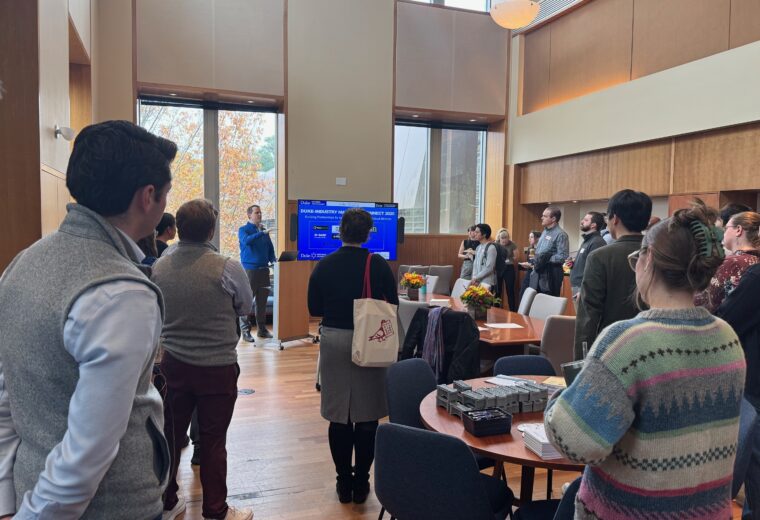
The Duke Materials Initiative and the Duke Critical Minerals Hub, in conjunction with Duke’s Office for External Partnerships, hosted the inaugural Duke-Industry Materials Connect event, an afternoon focused on collaboration, innovation, and networking across the broad space of materials science.
Cookie Consent
We use cookies to improve your experience on our site. By using our site, you consent to cookies.
Cookie Preferences
Manage your cookie preferences below:
Essential cookies enable basic functions and are necessary for the proper function of the website.
Name
Description
Duration
Cookie Preferences
This cookie is used to store the user's cookie consent preferences.
30 days
Google reCAPTCHA helps protect websites from spam and abuse by verifying user interactions through challenges.
Name
Description
Duration
_GRECAPTCHA
Google reCAPTCHA sets a necessary cookie (_GRECAPTCHA) when executed for the purpose of providing its risk analysis.
179 days
Google Tag Manager simplifies the management of marketing tags on your website without code changes.
Name
Description
Duration
td
Registers statistical data on users' behaviour on the website. Used for internal analytics by the website operator.