
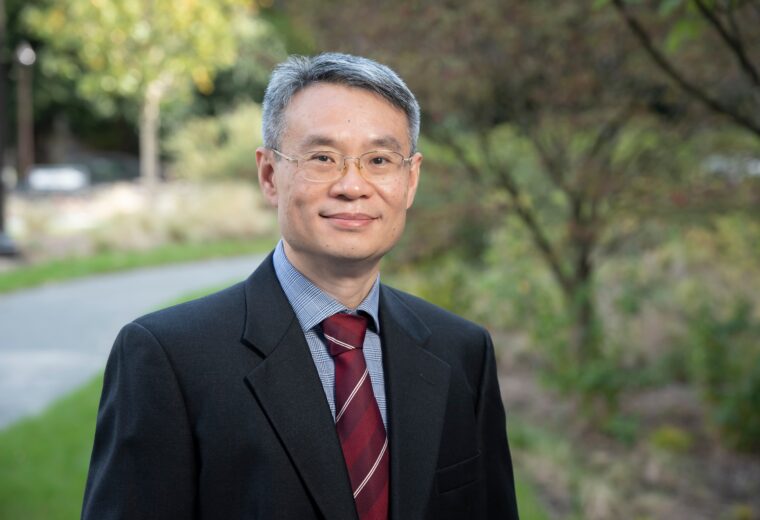
Duke’s Semiconductor Game Changers: Yiran Chen
Yiran Chen develops brain-inspired semiconductor hardware to enable faster, greener AI at the edge.
Tania Roy studies novel semiconductor materials and devices to advance energy-efficient computing and edge AI.

In January 2026, a landmark gift from the Lamond Family named the Pierre R. Lamond Department of Electrical and Computer Engineering (ECE) at the Pratt School of Engineering. The $57 million in total investment strengthens Duke ECE’s ability to shape the next era of computing technologies and fuel the department’s rapid rise in research and academic distinction.
The department’s namesake, Pierre R. Lamond, helped pioneer the semiconductor industry and later invested in semiconductor, systems and software companies as a venture capitalist in Silicon Valley.
In this series, Duke Engineering highlights faculty members whose work in semiconductor‑related research is already making an impact, and who are now positioned to accelerate that work through the transformative commitment from the Lamond Family.
Tania Roy is an associate professor of ECE and leads research on next-generation nanoelectronics materials and devices. Her work explores how emerging materials can enable new hardware architectures for AI, sensing and imaging.
I study the materials used to build electronic devices. Silicon has been the bedrock of modern electronics for decades and for good reason: It has incredible properties that make it an exceptional semiconductor. As we look toward the next phase of semiconductor innovation, however, my lab is focused on identifying new materials to complement, not replace, silicon.
I like to describe the future of semiconductor chips as a sandwich. Silicon will remain the key component, like the bread and meat. The “cheese” and other “toppings” will be layers of emerging materials stacked on top of one another to provide new functions. These might include two-dimensional materials that are only a few atoms thick, such as amorphous oxide semiconductors and gallium nitride.
Many of these materials have shown tremendous promise for improving the performance and efficiency of silicon, but we’re still in the early stages of integrating them. It will require close collaboration across materials science, physics and ECE in the coming years.
One of the biggest limitations of today’s electronics is that memory and computation are physically separated. In most systems, data is stored in one place and processed in another, which wastes both time and power. If we can bring computation and memory closer together within computer chips, we can make AI systems faster and more efficient. That will allow applications to operate in real time rather than relying on the cloud.
The potential of hardware-level edge computing is vast: Drones that fly autonomously deep into wildfire zones, smart glasses that translate language on the spot or robotic dogs that help visually impaired people navigate sidewalks—all requiring far less energy than today’s AI systems.
Our lab has developed pixel-level components for digital photography that not only capture light but also store and process information directly. This could allow cameras to identify objects, detect motion or sharpen images before any data ever leaves the device. It’s a completely new way of thinking about how hardware supports intelligence.
Duke ECE has a long history of collaboration, and faculty across the department have been working at different levels of the stack—from devices to neuromorphic circuits to architectures—which creates a strong foundation for semiconductor innovation. My work complements those strengths by focusing on the device level, particularly the materials that enable novel computing approaches.
The Wright brothers’ first flight at Kitty Hawk, N.C., in 1903 sparked an innovation chain around aviation that led to astronauts landing on the moon just 66 years later. The invention of the transistor in 1947 launched a similar wave, giving rise to integrated circuits, the internet and now AI.
Today, I believe building energy-efficient hardware for edge AI is the Manhattan Project of our generation, and just like the eras that came before, it will depend on talented engineers who are ready to build. It’s the right time to be in semiconductors. We have the ideas, we have the talent, and we’re building the hardware that will carry us to the next great leap.
Yiran Chen develops brain-inspired semiconductor hardware to enable faster, greener AI at the edge.

With advanced computing, semiconductors and AI hardware essential to national competitiveness, a transformative investment positions Duke to lead in computer engineering.

PhD students Dylan Matthews and Sazzadur Rahman presented amorphous oxide semiconductor research at the IEEE IEDM conference.