

Duke’s Semiconductor Game Changers: Haozhe “Harry” Wang
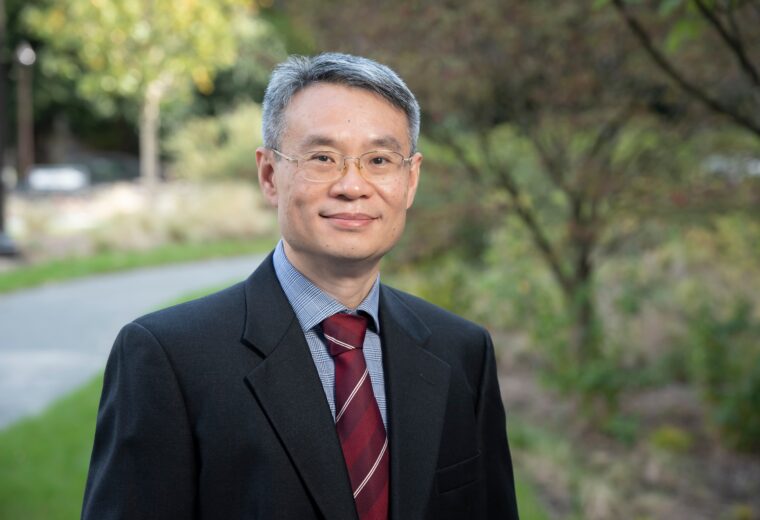
Haozhe “Harry” Wang pioneers atomic-scale semiconductor manufacturing to push electronics beyond silicon.
Hai “Helen” Li studies neuromorphic computing and AI hardware from a design and computer architecture perspective.

In January 2026, a landmark gift from the Lamond Family named the Pierre R. Lamond Department of Electrical and Computer Engineering (ECE) at the Pratt School of Engineering. The $57 million in total investment strengthens Duke ECE’s ability to shape the next era of computing technologies and fuel the department’s rapid rise in research and academic distinction.
The department’s namesake, Pierre R. Lamond, helped pioneer the semiconductor industry and later invested in semiconductor, systems and software companies as a venture capitalist in Silicon Valley.
In this series, Duke Engineering highlights faculty members whose work in semiconductor‑related research is already making an impact, and who are now positioned to accelerate that work through the transformative commitment from the Lamond Family.
Hai “Helen” Li is the chair and Marie Foote Reele E’46 Distinguished Professor of Electrical and Computer Engineering. Her research focuses on the design of next-generation computing systems, including neuromorphic computing, memory and storage technologies and hardware-software co-design.
My research in neuromorphic computing and AI hardware is deeply connected to semiconductor technology, primarily from a design and computer architecture perspective. I focus on developing next-generation hardware architectures that maximize performance and energy efficiency for intelligent systems. At the same time, I actively collaborate with researchers working on novel devices and emerging fabrication processes (Aaron Franklin and Tania Roy at Duke ECE and other external collaborators) to ensure that architectural innovation aligns with advances at the device and materials levels.
Before joining academia, I worked at Intel, Qualcomm and Seagate, three leading semiconductor companies. That industry experience shaped my understanding of the full stack, from devices and circuits to systems and large-scale deployment, and continues to inform my research approach today.
One major technical challenge is achieving dramatically higher energy efficiency while sustaining or improving computational intelligence.
Neuromorphic computing seeks to develop fundamentally new computer architectures inspired by the structure and mechanisms of the human brain. The human brain consumes only about 20 watts of power, yet it supports extraordinary cognitive capability and adaptability to dynamic environments. Replicating even a fraction of that efficiency in silicon remains one of the grand challenges of computing. My work aims to bridge this gap by rethinking data movement, memory organization and computation models.
On a more immediate timescale, AI hardware research addresses the urgent need to support rapidly evolving AI workloads, such as large language models (LLMs), generative AI and edge intelligence. These models are growing exponentially in size and complexity, creating enormous demands on compute, memory bandwidth and energy consumption. My work focuses on designing specialized accelerators, memory-centric architectures and cross-layer optimizations that deliver higher performance per watt and make advanced AI more scalable and sustainable.
Improved semiconductor hardware will significantly accelerate the transition from cloud-dominated AI to intelligent edge computing occurring inside devices.
Recent breakthroughs in machine intelligence, such as deep neural networks and large foundation models, have been driven by scaling laws and the availability of massive computational infrastructure. However, to truly benefit individuals, AI must move closer to where data is generated and decisions are made. With continued innovation in circuits, architectures, systems and networking, we can enable powerful AI models to run efficiently on small, personal devices such as smartphones, wearables, autonomous robots and health care monitors. This would unlock applications such as:
Ultimately, semiconductor innovation is key to enabling intelligence that is personalized, secure, energy-efficient and accessible to every individual.
Duke ECE has built strong momentum in semiconductor research through strategic faculty recruitment, interdisciplinary collaboration and sustained investment in research infrastructure.
We have expanded expertise across multiple layers of the semiconductor ecosystem, including materials and devices (Haozhe “Harry” Wang and Tania Roy), circuits, computer architecture, AI hardware, networking (Tingjun Chen), embedded systems (Miroslav Pajic), and emerging applications such as AR/VR (Maria Gorlatova) and wearable systems (James Morizio). By bringing together strengths in areas such as materials and processes, electronic design automation (Yiran Chen), computer architecture (Daniel Sorin), cyber-physical systems (Miroslav Pajic), optical systems (Adrienne Stiff-Roberts), and AI-driven hardware design (myself), we are building a holistic ecosystem.
Importantly, this growth is supported by strong experimental and computational infrastructure. Duke Engineering and ECE have invested in advanced micro- and nano-fabrication facilities, device characterization tools and state-of-the-art measurement and prototyping capabilities that enable rapid design iteration and validation. Our shared cleanroom environments, materials growth and processing equipment, high-resolution imaging and characterization tools and advanced packaging capabilities allow researchers to move seamlessly from device innovation to system-level demonstration. In addition, we maintain strong computing infrastructure to support large-scale AI model development, hardware simulation and design automation research.
This is a pivotal moment for semiconductor research both nationally and globally. The United States has identified semiconductor manufacturing, design and innovation as strategic priorities, as reflected in major federal initiatives such as the CHIPS and Science Act. These efforts aim to strengthen domestic semiconductor capability, enhance supply chain resilience and maintain global technological leadership.
At Duke, we see a unique opportunity to define our long-term vision in this rapidly evolving landscape. One of our central goals is to educate and prepare the next generation of semiconductor leaders. Developing a highly skilled, technically deep, and innovation-driven student body is essential to sustaining the industry’s future growth.
This mission requires tight integration between curriculum development and cutting-edge research. By combining strengths in semiconductor devices, circuits, architecture, computing and AI, areas where Duke ECE already excels, we aim to contribute to both national priorities and transformative technological advancement.
Haozhe “Harry” Wang pioneers atomic-scale semiconductor manufacturing to push electronics beyond silicon.

Tania Roy studies novel semiconductor materials and devices to advance energy-efficient computing and edge AI.
Yiran Chen develops brain-inspired semiconductor hardware to enable faster, greener AI at the edge.