From Coursework to Patient Care: Duke Design Health Team Innovates POTS Treatment
1/7/26Pratt School of Engineering
Student-led startup pursues award-winning treatment for patients with disruptions to their autonomic body processes.
SHARE
From Coursework to Patient Care: Duke Design Health Team Innovates POTS Treatment
When recent biomedical engineering graduates Kishen Mitra and Sara Taube joined Duke’s Design Health program as juniors in the spring of 2023, they became interested in dysautonomia, a group of conditions affecting the body’s automatic functions.
While not a common illness in the public vernacular, the effects of dysautonomia are eye-catching. One such condition called Postural Orthostatic Tachycardia Syndrome (POTS) is the result of the nervous system failing to properly regulate blood flow. Afflicting 3 to 6 million Americans, the condition causes up to 30% of patients’ blood to pool in their abdomen and legs, leading to debilitating symptoms such as dizziness, fatigue, rapid heart rate and “brain fog.”
Half of POTS patients lose their jobs and a quarter become fully disabled. But statistics alone aren’t what pulled the pair into a quest to better treat the disease.
Kishen Mitra, Shruthi Parameswaran, Lokesh Manivannan and Sameer Kunte pose together in Duke’s Innovation Co-Lab.
“When someone close to me was diagnosed with POTS, I witnessed firsthand how difficult it is to navigate a condition that so few people understand,” Mitra said. “I soon learned that other people in my life were also affected, and I came to realize just how underserved this patient population is. I was determined to help change that, and Design Health seemed like a perfect fit for that goal.”
For more than a decade, Design Health has brought together students from engineering, medicine, business and other fields, immersing them in real-world clinical settings where they identify pressing issues and develop practical solutions for patients and clinicians. This approach to medical device innovation has proven highly effective, with Design Health teams consistently earning recognition in international competitions and successfully translating their classroom projects into commercial ventures.
The program’s emphasis on human-centered design and patient engagement creates solutions that address genuine health care needs. Now, with several competition wins and a medical device start-up company underway, the dysautonomia-focused project has become one of the program’s most impactful in its history.
When someone close to me was diagnosed with POTS, I witnessed firsthand how difficult it is to navigate a condition that so few people understand.
Kishen MitraCo-Founder & CEO, Levita Health
Where Needs Find Solutions
Once Mitra and Taube joined Design Health, they quickly formed a team with Master of Engineering students Lokesh Kumar Manivannan and Shruthi Parameswaran as well as medical student Sameer Kunte. Under the guidance of Eric Richardson, director of Design Health, the team began working with Duke cardiologist Dr. Marat Fudim, interviewing patients who have POTS and related conditions.
These conversations revealed a disconnect between what doctors recommended and what worked in practice.
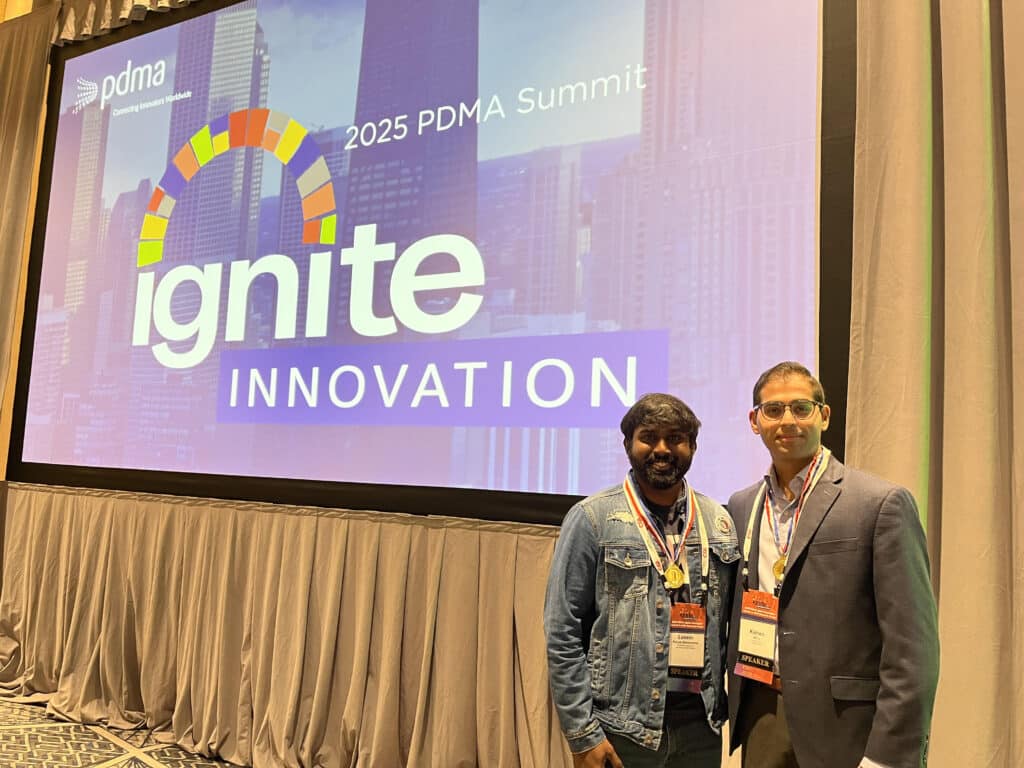
The founders of Levita Health have competed in several innovation challenges, such as the PDMA Global Student Innovation Challenge, securing prize funding, mentorship connections and valuable experience refining their business strategy.
“Compression therapy is one of the first things we recommend for POTS patients, but the reality is that most products on the market just don’t work well for them,” said Dr. Fudim. “They’re either too uncomfortable to wear throughout the day or they don’t deliver enough pressure where it’s needed most. Patients end up cycling through product after product, searching for something that actually helps.”
To quantify Dr. Fudim’s anecdotal observations, the team partnered with both Duke’s Syncope Clinic and Dysautonomia International, a leading patient advocacy organization. This unique collaboration with a nonprofit enabled the team to conduct a comprehensive study surveying hundreds of patients with POTS across the country. The findings were striking: While nearly all patients had tried compression garments, very few found them effective.
Duke Design Health
Finding real-world solutions to clinical problems while providing students with a crash course on entrepreneurship in the med tech industry.
The team set out to design something better. They developed three generations of prototypes, gathering feedback from patients through interviews and design sessions. This iterative process helped them refine their concept to be both effective and practical for real-world use.
“Coming up with the concept was just the starting point,” said Manivannan. “We spent months working through the details. How do you deliver consistent compression? How do you make it adjustable while preventing slippage across different body types? Every time we solved one problem, another one emerged.”
“There was always an underlying question of whether we could actually deliver therapeutic levels of compression,” Mitra recalled. “When we tested our prototype and confirmed that we could, I’ll never forget that moment. After everything, we finally had something that could genuinely help patients.”
When I mention that we’re creating something new, their eyes light up. There’s real hope in this community for a solution that actually fits into their lives.
Camille Frazier-MillsMD, MHS Electrophysiologist, Duke University School of Medicine
From Classroom to Clinic
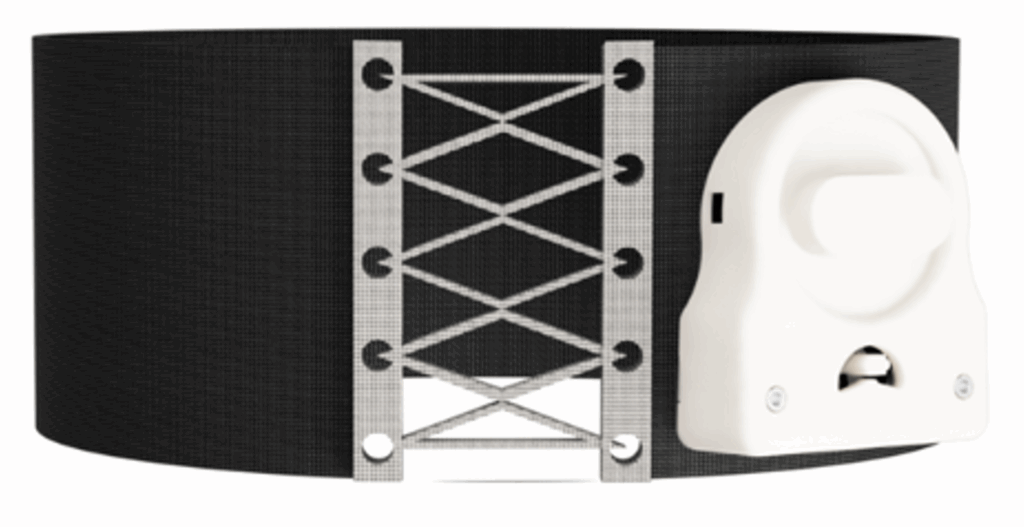
All of that work eventually paid off with a device called Uplift. The innovation takes a fundamentally different approach to abdominal compression, featuring an adjustable mechanism that allows patients to engage and disengage compression as needed throughout the day. Uplift uses a patent-pending cinching system that delivers therapeutic pressure while maintaining comfort for extended wear. Unlike existing products, patients can easily modify the compression level when changing positions.
The team then validated their invention through rigorous clinical testing with 47 healthy participants. The results showed that Uplift effectively stabilized heart rate and blood pressure responses during position changes, demonstrating the physiological benefits that could help POTS patients manage their daily symptoms.
Dr. Camille Frazier-Mills, director of Duke’s Syncope Clinic, has seen how eager patients are for better options. “When I mention that we’re creating something new, their eyes light up,” she said. “There’s real hope in this community for a solution that actually fits into their lives.”
A rendering of the Uplift device featuring an adjustable mechanism that allows patients to engage and disengage compression as needed throughout the day.
The team’s work has earned accolades on the global stage. They were selected as Graduate Finalists for the prestigious Stu Clark New Venture Championships, competing among just 16 teams in North America. They also were recognized as winners of the PDMA Global Student Innovation Challenge from a pool of 70 teams around the world. Beyond the recognition, these competitions provided prize funding, mentorship connections and valuable experience refining their business strategy.
Through all of their work, the team has also built strong connections with patient advocacy organizations, including a presentation at the Dysautonomia International research conference and an appearance on The POTScast, a popular podcast within the POTS community.
Building on this momentum, Mitra founded Levita Health, which is currently raising a pre-seed funding round. Duke’s comprehensive support ecosystem enabled the team’s transition from student project to commercial venture. The Christensen Family Center for Innovation provided prototyping funding and resources, Duke Innovation & Entrepreneurship awarded Duke Student Startup Funding, and mentorship from Dr. Richardson and Dr. Joe Knight, another Design Health leader, offered essential guidance on medical device development and commercialization.
As the fledging company prepares to launch Uplift in the coming years, their goal of transforming compression therapy for patients with circulation-related symptoms is nearly within sight.
“We’re just getting started,” Mitra said. “As Levita Health grows, we’re committed to education and outreach that helps this community beyond just our device. It’s been a long road to get here, and we can’t wait to finally put something in patients’ hands that makes a difference.”
Learn more about Levita Health at their website or follow their progress on LinkedIn.
Adam Wax received one of the top honors for academic inventors in recognition of his work to translate research in optical spectroscopy to biomedical diagnostics.
Duke University’s A. James Clark Scholars program provides full tuition and financial aid support to promising students who will develop into tomorrow’s engineering leaders.
Cookie Consent
We use cookies to improve your experience on our site. By using our site, you consent to cookies.
Cookie Preferences
Manage your cookie preferences below:
Essential cookies enable basic functions and are necessary for the proper function of the website.
Name
Description
Duration
Cookie Preferences
This cookie is used to store the user's cookie consent preferences.
30 days
Google reCAPTCHA helps protect websites from spam and abuse by verifying user interactions through challenges.
Name
Description
Duration
_GRECAPTCHA
Google reCAPTCHA sets a necessary cookie (_GRECAPTCHA) when executed for the purpose of providing its risk analysis.
179 days
Google Tag Manager simplifies the management of marketing tags on your website without code changes.
Name
Description
Duration
td
Registers statistical data on users' behaviour on the website. Used for internal analytics by the website operator.