Duke’s Design Defense Studio Trains Troops to Think Like Professional Innovators
By Ken Kingery
8/22/25Pratt School of Engineering
Intensive program gives service members the tools to pitch, prototype and scale defense innovations that address real battlefield needs while earning credit toward a graduate engineering certificate or master’s degree.
SHARE
Duke’s Design Defense Studio Trains Troops to Think Like Professional Innovators
When it comes to national defense, every advantage could mean the difference between success and failure, between life and death, no matter how small. But implementing change within the armed forces can also be difficult due to the many layers of administrative approvals required and the shroud of secrecy much of their inner workings maintain.
One solution to this ever-present challenge is training the highly capable personnel already within the military on how to bring innovative ideas to life inside big, successful organizations. That’s the idea behind Duke’s Design Defense Studio, a 10-week crash course in the process of innovation that culminates in “intrepreneurial” pitches to military leaders in positions to fund them.
Taught by husband-and-wife duo Robb and Kate Olsen, the program is based on a Duke Master of Engineering Management course called eLuminate Studio. Through three week-long intensive on-campus working sessions interspersed with at-home work, servicemembers take intellectual property opportunities from Duke or potential industry partners and create propositions for how they might solve an existing challenge.
This is tough stuff. But our students seek to achieve excellence, and they often reach that goal, emerging as masterful integrators who can do impactful innovation anywhere in the world.
Robb OlsenCo-creator and Professor of Design Defense Studio
The program is a partnership with ARCWERX, which creates and fosters a lasting culture of innovation in the collective reserve forces of the U.S. Air Force, building on the unique structure, geographic distribution and talents of individual guardsmen and reservists.
“Mission alignment and funding alignment with decision-makers is key, as is warfighter alignment and potential industry partners who can provide the enabling technologies for the solutions,” said Robb Olsen. “This is tough stuff. But our students seek to achieve excellence, and they often reach that goal, emerging as masterful integrators who can do impactful innovation anywhere in the world.”
For example, KJ Lee is a 22-year veteran assigned to Special Forces Command who knows how long it takes to get new technologies approved for live action use. Through this year’s program, Lee and his team have developed a sensor network platform that can tie into all existing and future technologies to provide a holistic view of an active warzone using machine learning.
“It’s something that can hook new technologies into as they come online to allow them to be deployed without going through a years-long review and approval process,” explained Lee. “If we do this thing right, we’re going to build one super system that everyone can tie into, whether they’re guarding the Super Bowl or the Olympics, or if it’s a soldier stationed overseas and everywhere in between.”
Lee is optimistic about the technology’s chances of success. He knows a good idea when he sees it. As part of a similar program several years earlier called Academia-Industry-Military Hybrid Innovation (AIM-HI, also taught at that time by the Olsens), Lee and the AIM-HI team, including current Design Defense Studio coaches Rick Boyer and Tony Hall, helped launch a successful technology currently in use around the world today.
That idea centered around the idea of creating a one-stop secure communications network that anyone using any technology can easily tie into. Different branches of the military sometimes use different communications equipment protocols, as do allies from various nations around the world.
The AIM-HI team created a prototype network using dozens of MPU5 cloud relay radios across thousands of heavily wooded acres in the North American All-Domain Warfighting Center (NADWC), a training facility located in northern Michigan. These radios created a secure mesh communications network that allowed various defense communications systems to easily talk to one another.
This project from 2024’s iteration of Design Defense Studio is called DarkStar. Its leaders have already secured almost $2 million in funding through the SBIR program to develop key enabling technologies.
“We figured out a way to allow various units to plug and play their own comms systems, radios, data collection, video—whatever—into an established secure network and get them to all work together,” Lee said during a case study presentation of how these types of projects can succeed. “Now the Navy, the United Kingdom’s Royal Marines, and other international partners like Latvia, Estonia and Poland are all using it, too.”
“Design Defense Studio is establishing a track record of successfully accelerating innovations on the path to warfighter adoption,” said Robb Olsen. “Several of our teams have made rapid progress, all the way to global use and deployment, that would not have been possible except for the passion and commitment of our Design Defense Studio students.”
I wanted a program where some of it would be in-person and I would be able to be a part of a community. The more I came to Duke, the more I wanted to stay, and it just became increasingly clear that this was the right decision for me.
Jacquelyn FischerSpectrum Manager, The MIL Corporation
Even with this success story in hand, Lee decided to come back for another summer program of innovation training this year. Part of his reasoning is that Design Defense Studio is now the launching point of a four-course sequence through which servicemembers can attain a Duke Defense Innovation Certificate. And that certificate gets them halfway to a Master of Engineering Management (MEM) degree.
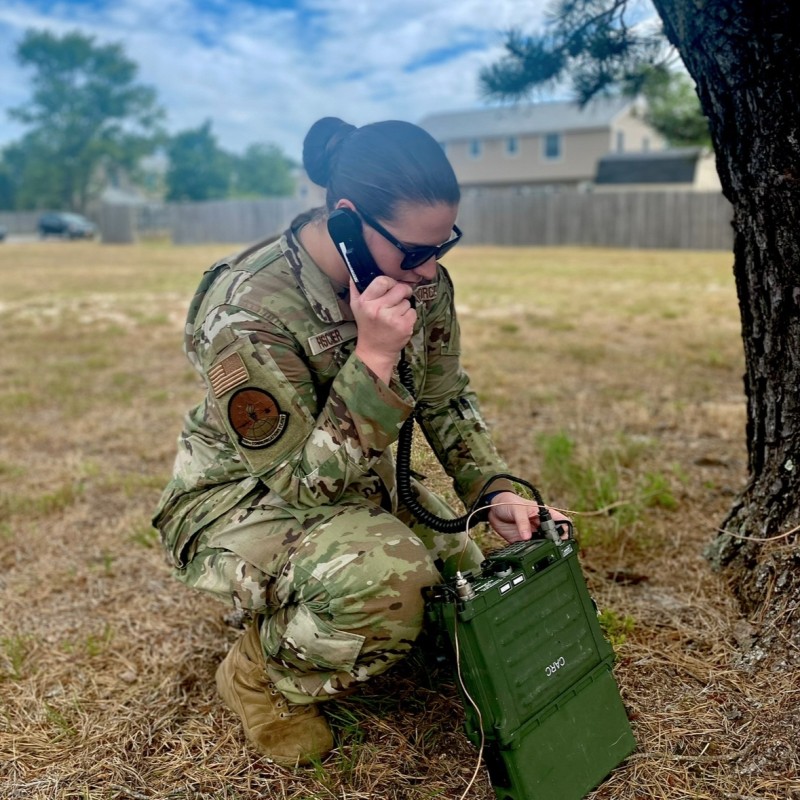
That pathway to a master’s degree is also a major bonus to Jacquelyn Fischer, another participant in this year’s program. A spectrum manager for the Air National Guard and data analysis team manager for The MIL Corporation, Fischer describes herself as someone that is continuously relentless in improving her skillset.
“I’ve done all sorts of agile methodologies for implementing new technologies, and I’ve wanted to bring that back to the military,” Fischer said. “I heard about this program that sponsors this innovation training, and I knew I had to take it.”
After getting accepted to a master’s program at Columbia University, Fischer heard about the Design Defense Studio opportunity and decided to apply for that as well.
Her team’s project focuses on keeping ground forces safe from unexpected drone attacks and electronic warfare like communications jamming. Using inexpensive, off-the-shelf electronics, the system called “Graybeard” passively monitors for any electromagnetic signatures within its range. Connecting to an AI system in the cloud, it compares any incoming signals with known threats to create a fast and reliable threat assessment for any unexpected detections.
Regardless of the project’s eventual success, Fischer knows her time in Design Defense Studio has been well worth her time and investment. After learning about the certificate and how it segues to the online MEM program, she ultimately decided to enroll at Duke. She cites the master program’s faculty, students, flexibility and community as the main drivers of her decision.
“I wanted a program where some of it would be in-person and I would be able to be a part of a community,” Fisher said. “The more I came to Duke, the more I wanted to stay, and it just became increasingly clear that this was the right decision for me.”
Adam Wax received one of the top honors for academic inventors in recognition of his work to translate research in optical spectroscopy to biomedical diagnostics.
Duke University’s A. James Clark Scholars program provides full tuition and financial aid support to promising students who will develop into tomorrow’s engineering leaders.