Quelling Chaos Through Clever Control System Construction
By Ken Kingery
9/23/25Pratt School of Engineering
Leila Bridgeman is steadily laying foundations for the software needed to precisely control the large, complex networks of individual agents underscoring a wide range of applications from autonomous drones to laser-wielding surgical robotics.
SHARE
Quelling Chaos Through Clever Control System Construction
Control systems are all around us in the modern world. If they’re doing their jobs right, nobody ever notices them. But once they begin to break down, the modern conveniences we have all become so accustomed to begin to fail.
Computers within our cars ensure that power is distributed correctly to all four wheels while maintaining cruising speed and avoiding immediate threats. HVAC systems distribute heating and cooling throughout enormous spaces using dozens of individual units at once. Our nation’s power grid is constantly balancing the supply and demand of hundreds of gigawatts produced by a complex network of power plants of various capabilities.
The techniques that prevent control systems’ failures usually couple all the individual pieces of a control system together. But as these networks become larger and more complex, incorporating many different types of technologies with different goals, they start to struggle. Just imagine how complex it would be to model and understand every element of our national power grid, all at once; nobody knows how to do that!
Bridgeman’s Office of Naval Research Young Investigator Award helped her group help unlock the potential of historically underappreciated control theory to solve modern challenges of controlling fleets of autonomous vehicles.
For the past three years, Leila Bridgeman has been mining the ideas of past control theorists for new approaches to these increasingly complicated problems. Just because these ideas were not chosen for development in simpler systems does not mean their approaches aren’t applicable to modern complexities.
“The main idea we chose to pursue essentially breaks one big problem down into small separate problems,” said Bridgeman, whose work has been supported by a prestigious Office of Naval Research (ONR) Young Investigator Award. “It was described in some papers from the 1970s that people mostly forgot, but it’s been a treasure trove for my group, and I’m continually surprised at how well the framework performs.”
The main idea we chose to pursue essentially breaks one big problem down into small separate problems. It was described in some papers from the 1970s that people mostly forgot, but it’s been a treasure trove for my group.
Leila BridgemanAssistant Professor in the Thomas Lord Department of Mechanical Engineering and Materials Science
Through a string of papers published in a variety of peer-reviewed journals, Bridgeman has discovered that these largely forgotten approaches provide multiple benefits. At first, she thought the theory would mainly benefit the functionality of large groups of disparate individuals, like a fleet of autonomous drones working together on land, sea and air. But it proved to be much more powerful.
When large groups of computerized objects interact with one another, reliable lines of communication are essential. But what if wireless connections flicker from time to time? Or what if their individual communications protocols prove incompatible?
Duke Robotics
A cross-disciplinary association of research labs and teaching faculty conducting world-class research and training future generations of leaders, thinkers and creators.
“We recently realized that the approach provides simple rules to check that changing communications don’t cause controllers to spiral out of control,” Bridgeman said. “It made an enormous problem into one that suddenly doesn’t seem so bad.”
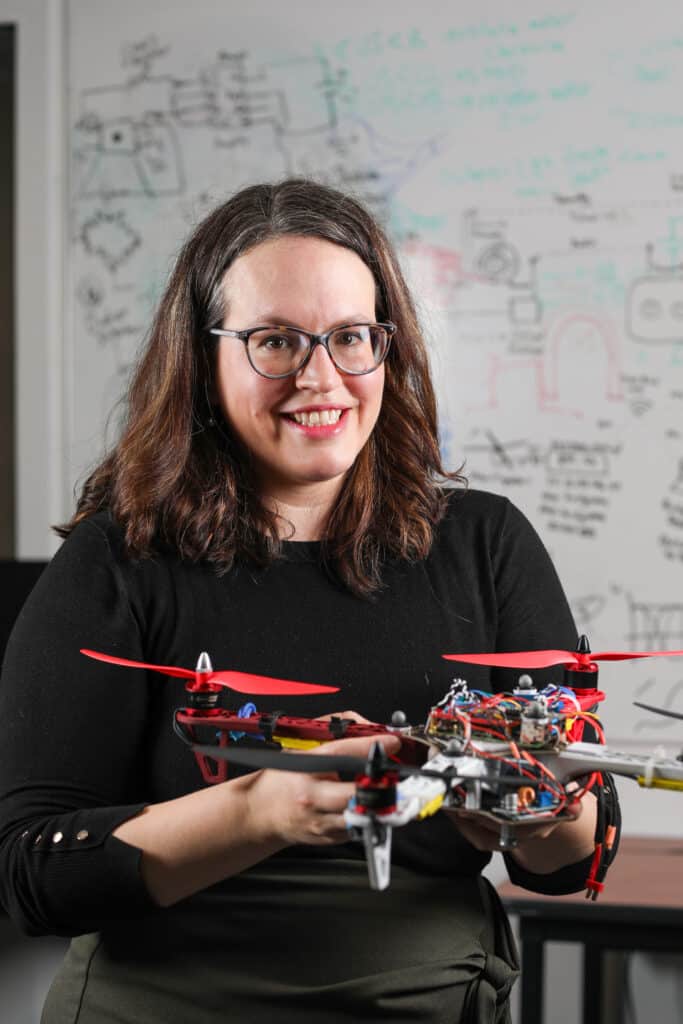
Leila Bridgeman in her laboratory in Duke University’s North Building.
Another prong of Bridgeman’s work in collaboration with researchers at the University of New Mexico focuses on the data-driven analysis of invariant sets. While the term sounds like a mouthful, it essentially means using direct observations rather than ground-up mathematics to develop conditions where a system is safe.
Imagine a hockey player zipping across an ice rink. Ideally, that skater wants to avoid crashing into the walls whenever possible. If that player were operated by an autonomous control system, we’d want it to protect the player from harm as long as they remained on the ice.
There would clearly be, however, locations and speeds that, when combined, would inevitably lead to disaster. On the other hand, there would be a large set of locations and speeds that the player could recover from no matter what. In control theory terms, that mathematical safe space is known as an invariant set.
“Even if a control system is 99.999999% perfect for each step, it’s not good enough if there are a million steps involved,” Bridgeman explained. “Finding invariant sets is pretty much the only way to certify safety. The big goal of this research is to allow the design of AI controllers that won’t accidentally break the world—or the people—they interact with.”
Even if a control system is 99.999999% perfect for each step, it’s not good enough if there are a million steps involved.
Leila BridgemanAssistant Professor in the Thomas Lord Department of Mechanical Engineering and Materials Science
Through these projects over Bridgeman’s seven-year tenure at Duke, she has advised three PhD students who have graduated and is currently supporting four more working toward their doctorates. And outside of her research portfolio, she brings these concepts and ideas to dozens of students through her undergraduate course called “Control of Dynamic Systems” and a graduate level course called “Model Predictive Control.”
Looking toward the future as her ONR award draws to a close, Bridgeman says she has several ideas for projects that are adjacent to or directly related to the work she’s been pursuing these past few years. With dozens of labs around the world dedicated to these topics, she has no shortage of potential collaborators and funding interest in her field.
Outside of this global community, Bridgeman is also finding plenty of collaborators right here at Duke. One project she’s working on involves developing an automated ultrasound system that can scan for cancer in soft tissues such as breast cancer, which is difficult since small forces can cause large deformations.
Another project she is especially proud of involves faculty at the Duke University School of Medicine who are working on advanced medical robotics. Their goal is to develop a platform that can autonomously use lasers to perform delicate surgeries that remove tumors and destroy cancerous tissue.
“Robotic systems have higher precision than a surgeon’s hands, but these procedures also come with a lot of uncertainties with how tissue reacts to heat and what can be seen,” Bridgeman said. “It’s a hard problem to pose in a way that a computer can solve, but it’s a fun one because it involves a lot of fun control theory and mathematics.”
Award will help unlock the potential of historically underappreciated control theory to solve modern challenges of controlling fleets of autonomous vehicles
A new Master of Engineering in Robotics & Autonomy program joins Duke’s undergraduate and graduate certificates for aspiring technology leaders
Cookie Consent
This website uses cookies as well as similar tools and technologies to understand visitors' experiences. By continuing to use this website, you consent to Duke University's usage of cookies and similar technologies, in accordance with the Duke Privacy Statement.
Cookie Preferences
Manage your cookie preferences below:
Essential cookies enable basic functions and are necessary for the proper function of the website.
Name
Description
Duration
Cookie Preferences
This cookie is used to store the user's cookie consent preferences.
30 days
Google reCAPTCHA helps protect websites from spam and abuse by verifying user interactions through challenges.
Name
Description
Duration
_GRECAPTCHA
Google reCAPTCHA sets a necessary cookie (_GRECAPTCHA) when executed for the purpose of providing its risk analysis.
179 days
Google Tag Manager simplifies the management of marketing tags on your website without code changes.
Name
Description
Duration
td
Registers statistical data on users' behaviour on the website. Used for internal analytics by the website operator.