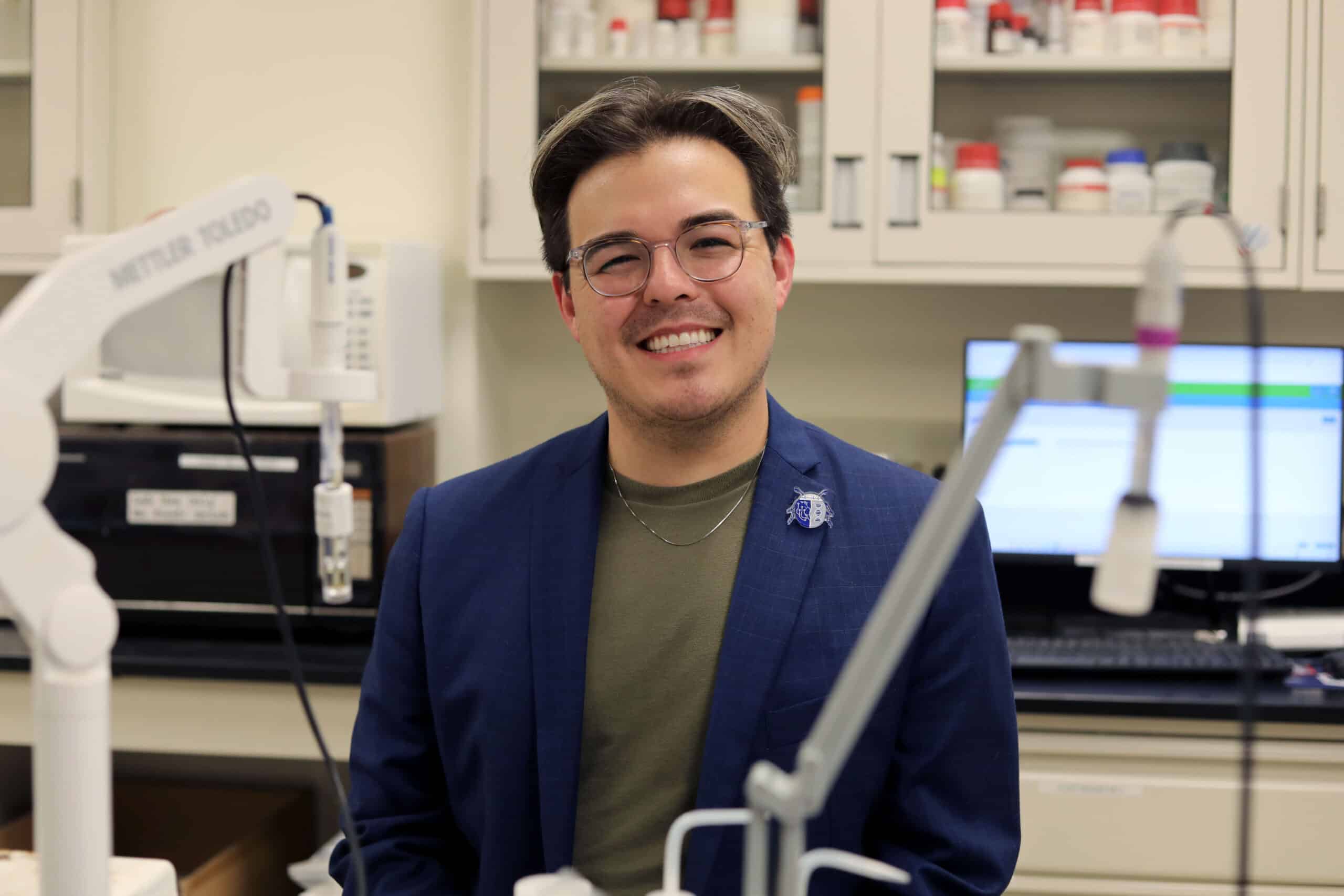
Cameron Kim Receives ASEE Biomedical Engineering Teaching Award
Michaela Martinez
8/11/25Awards
Kim was recognized for his leadership in the field of engineering education
SHARE
Cameron Kim Receives ASEE Biomedical Engineering Teaching Award
Cameron Kim, an assistant professor of biomedical engineering (BME) at Duke University, received the Biomedical Engineering Teaching Award from the American Society for Engineering Education (ASEE). Conferred by the Biomedical Engineering Division (BED), the award celebrates early-career faculty members who are pioneering innovative teaching programs and approaches.
Kim was recognized for his work to revitalize Duke BME’s biotechnology curriculum, which included updating and expanding the lab courses offered to BME students. Working with faculty members who specialize in biotechnology, Kim helped create two new upper-level courses and took over leadership for the two-semester senior biotechnology design capstone course. Kim also received a competitive R25 grant on Team-Based Design in Biomedical Engineering Education from the National Institute of Health National Institute of Biomedical Imaging and Bioengineering (NIBIB) Research Education Program in 2024 to further support these expansive efforts.
“Despite strong faculty dominance in biotechnology in our department, there was little focus on updating our biotech lab offerings for students,” said Libby Bucholz, the Claude B. Williams and David M. Hessee Associate Professor of the Practice in Duke BME. “But Cameron’s changes have resulted in our senior biotech design course becoming the most popular senior design program in the department. His efforts have already transformed our biotech program, and I believe his contributions to Duke BME are just beginning.”
Beyond his work to update the biotechnology curriculum, Kim also worked with The Kenan Institute for Ethics and Duke Science and Society Initiative to design and launch BME290: Ethics in Bioengineering, the first course in the department entirely dedicated to ethics and how they may influence the application of biomedical tools, such as human genome editing and machine learning in health care.
“So many of these technologies are evolving and changing in ways that necessitates us talking about them now. For example, what CRISPR can achieve today is different than what was possible even three years ago,” said Kim. “What we do as engineers doesn’t occur in a societal, ethical or legal vacuum, and I wanted a course for our students to explore the possible impacts of the work we do as biomedical engineers.”
So many of these technologies are evolving and changing in ways that necessitates us talking about them now. For example, what CRISPR can achieve today is different than what was possible even three years ago. What we do as engineers doesn’t occur in a societal, ethical or legal vacuum, and I wanted a course for our students to explore the possible impacts of the work we do as biomedical engineers.
Cameron KimAssistant Professor of Biomedical Engineering
Kim expanded this ethics-forward focus by working with faculty and department leaders to ensure lectures and ethical exercises are integrated into courses throughout the wider BME curriculum. He is continuing these efforts through the newly developed Biomedical Engineering Education & Teaching Laboratory (BEETL), co-directed with Sonia Bansal, an assistant professor of the practice in BME.
“I am truly humbled to receive this award and am grateful for the supporting BME education community that we have at Pratt that have been instrumental in my early career. The mentorship that I have received, especially from Ann Saterbak and Libby Bucholz, have been foundational to the work and I cannot thank them enough. But I could not do what I do without the amazing students in Duke BME and their drive for innovation and curiosities of the world around us.”
Cookie Consent
We use cookies to improve your experience on our site. By using our site, you consent to cookies.
Cookie Preferences
Manage your cookie preferences below:
Essential cookies enable basic functions and are necessary for the proper function of the website.
Name
Description
Duration
Cookie Preferences
This cookie is used to store the user's cookie consent preferences.
30 days
Google reCAPTCHA helps protect websites from spam and abuse by verifying user interactions through challenges.
Name
Description
Duration
_GRECAPTCHA
Google reCAPTCHA sets a necessary cookie (_GRECAPTCHA) when executed for the purpose of providing its risk analysis.
179 days
Google Tag Manager simplifies the management of marketing tags on your website without code changes.
Name
Description
Duration
td
Registers statistical data on users' behaviour on the website. Used for internal analytics by the website operator.