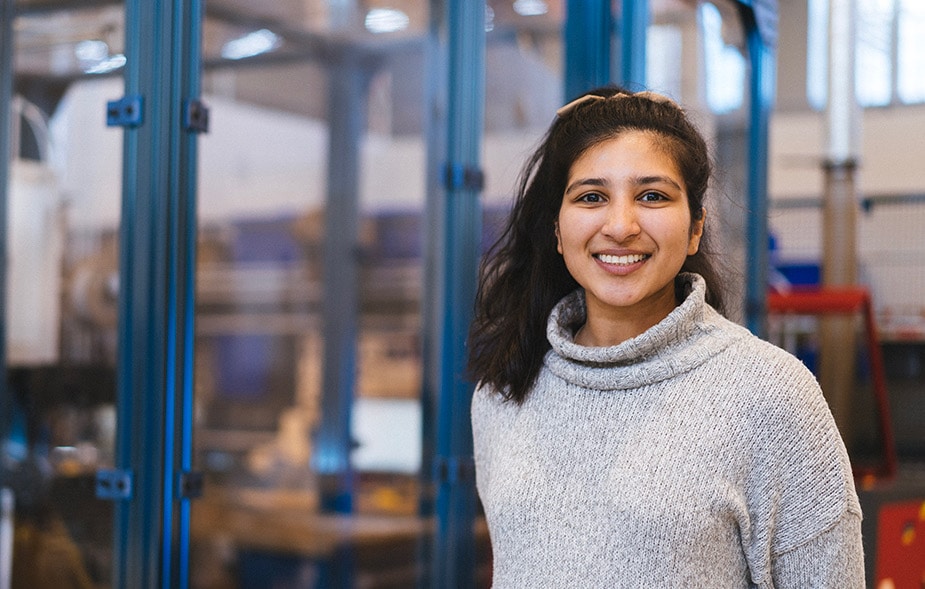
Sonia Bansal Named 2026 Engineering Unleashed Fellow
Michaela Martinez
9/16/26Awards3 min read
Bansal was recognized for a final project proposal that challenges students to balance technical know-how and real-world challenges
SHARE
Sonia Bansal Named 2026 Engineering Unleashed Fellow
Sonia Bansal, an assistant professor of the practice in Duke University’s Department of Biomedical Engineering, was named a 2026 Engineering Unleashed Fellow by the Kern Entrepreneurial Engineering Network (KEEN). The fellowship recognizes educators who are embedding entrepreneurial mindset throughout the educational experience, helping students develop curiosity, recognize opportunities, persist through challenges and create value through engineering.
Bansal was recognized for her innovative approach to engineering education and her work to develop engineering projects that prepare students to address complex, real-world challenges.
As one of 30 faculty members selected for the 2026 fellowship, Bansal will receive $10,000 in funding through the Kern Family Foundation to develop an educational toolkit for fellow faculty teaching design courses. During a pilot for the project, Bansal developed a final assignment in her biomaterials course called the “Design Innovation Challenge.” During the initial implementation of the project, students were tasked with pitching a next-generation medical device that could be built using foundational knowledge from the course. Although students did not need to prototype a functional device, they were required to consider not only the technical challenges that come with device development, but also the clinical, economic, regulatory and environmental factors that would influence its creation and eventual use.
The funding will support Bansal as she develops editable framework that gives students a practical tool for identifying stakeholders, understanding their needs and connecting those needs to decisions about technology, implementation and impact. By revisiting their ideas and incorporating feedback after reaching key milestones, students learn to refine incomplete ideas, learn from failure and build confidence when navigating ambiguity.
“This design canvas gives students a way to practice thinking like entrepreneurs by integrating sociotechnical evidence with stakeholder needs to help clarify and justify value,” said Bansal. “It challenges them to consider who they are designing for, what those stakeholders need and how decisions at one level can affect outcomes at another.”
This design canvas gives students a way to practice thinking like entrepreneurs by integrating sociotechnical evidence with stakeholder needs to help clarify and justify value. It challenges them to consider who they are designing for, what those stakeholders need and how decisions at one level can affect outcomes at another.
Sonia Bansalassistant professor of the practice
Since joining Duke BME in 2023, Bansal has focused on creating learning experiences that prepare students for the ambiguity and complexity they will encounter beyond the classroom. Her approach reflects a broader goal of entrepreneurial-minded learning: giving students the tools to identify opportunities, work through uncertainty and develop solutions that create meaningful value.
The Engineering Unleashed Fellowship will give Bansal an opportunity to further develop her approach and share it with a national community of engineering educators. The 2026 cohort includes faculty from 23 institutions across the United States, whose projects are intended to influence not only their own students and institutions, but engineering education more broadly.
For Bansal, the fellowship represents an opportunity to continue reimagining how biomedical engineers learn to approach problems—and how they can develop the systems-thinking skills needed to create solutions with meaningful, lasting impact.
“I am deeply thankful to the Kern Family Foundation for supporting this work and my faculty development more broadly,” Bansal said. “Design and the entrepreneurial mindset go hand in hand, and I am excited to connect the two in my classroom.”
Cookie Consent
This website uses cookies as well as similar tools and technologies to understand visitors' experiences. By continuing to use this website, you consent to Duke University's usage of cookies and similar technologies, in accordance with the Duke Privacy Statement.
Cookie Preferences
Manage your cookie preferences below:
Essential cookies enable basic functions and are necessary for the proper function of the website.
Name
Description
Duration
Cookie Preferences
This cookie is used to store the user's cookie consent preferences.
30 days
Google reCAPTCHA helps protect websites from spam and abuse by verifying user interactions through challenges.
Name
Description
Duration
_GRECAPTCHA
Google reCAPTCHA sets a necessary cookie (_GRECAPTCHA) when executed for the purpose of providing its risk analysis.
179 days
Google Tag Manager simplifies the management of marketing tags on your website without code changes.
Name
Description
Duration
td
Registers statistical data on users' behaviour on the website. Used for internal analytics by the website operator.