
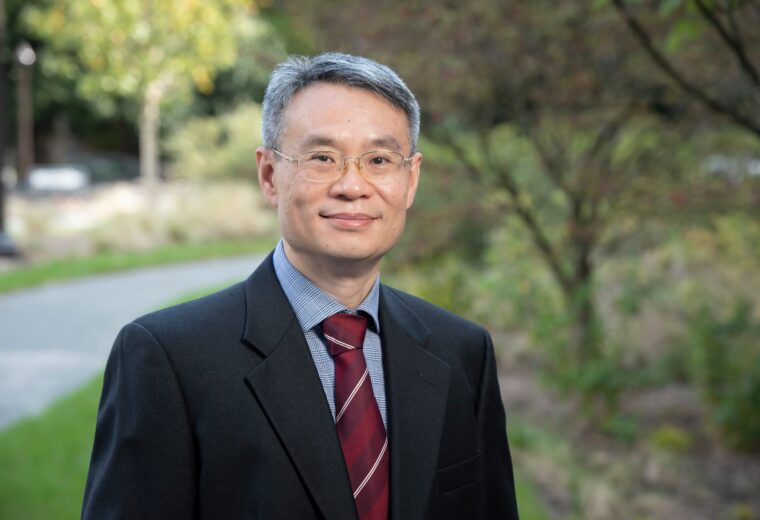
Duke’s Semiconductor Game Changers: Yiran Chen
Yiran Chen develops brain-inspired semiconductor hardware to enable faster, greener AI at the edge.
Yiran Chen develops brain-inspired semiconductor hardware to enable faster, greener AI at the edge.

With advanced computing, semiconductors and AI hardware essential to national competitiveness, a transformative investment positions Duke to lead in computer engineering.

Duke engineers publish new method to use analog radio waves to boost energy-efficient edge AI.

New AI system analyzes data to help scientists understand complex systems that change over time.

PhD students Dylan Matthews and Sazzadur Rahman presented amorphous oxide semiconductor research at the IEEE IEDM conference.

Litchinitser was honored for contributions to the photonics field, including antiresonant photonic-crystal fibers and structured light engineering.

Tingjun Chen part of a new $3.8 million NSF grant for COSMOS³, a project to expand and enhance New York City’s urban wireless testbed in West Harlem.

Chen joins a multi-institution team to advance analog neural network accelerators toward large-scale deployment.

Through pioneering neuromorphic computing research, Yiran Chen is developing brain-inspired hardware neurons that could lead to faster, smarter and more energy‑efficient AI.

Several interdisciplinary projects are using virtual and augmented reality to push the frontiers of physical and mental therapies.

Household robots and AI assistants illustrate how personality can make technology more approachable, while also amplifying ethical dilemmas.

Smartwatches and fitness trackers are becoming useful clinical health tools, and privacy considerations are key