The five-year renewal will focus on developing an AI-native edge stack that supports autonomous interaction among users, agents and the physical environment, integrated with national-priority technologies such as quantum computing.
SHARE
Duke’s Athena AI Institute Renewed Through 2031
The National Science Foundation has renewed funding for the Duke-led AI Institute for Edge Computing and Systems (Athena). Backed by $15 million over the next five years, the academic-industry-government partnership will work to realize a vision of “Immersive AI in the Physical World.”
During its initial five-year mission, Athena worked to transform modern edge computing through AI technologies, also known as Edge AI. Edge computing generally refers to any situation where processing takes place on, or as close as possible, to the device in question rather than sending queries to the cloud.
As early AI technologies emerged, they were often too power hungry and computationally intensive to work effectively in circumstances with limited access to the cloud, where much of the processing was performed. By distributing this workload across local edge devices while developing more efficient on-device hardware and AI models, Athena developed Edge AI technologies to overcome these limitations.
By enabling powerful AI models to be run on locally distributed systems and hardware, or on the AI-powered devices themselves, Athena is building capacity for futuristic technologies such as teams of air and land drones that can search dangerous situations where humans cannot enter.
Now, as AI evolves into generative and agentic systems, Athena will build on its foundational work to match pace. The center will focus its next five years on developing autonomous AI technologies and advancing long-lived, self-adaptive and self-evolving edge AI that enables unprecedented levels of interaction and coordination across edge systems, human users and the physical world.
“This is a natural progression of Athena’s work that also matches the emerging societal needs of this powerful technology,” said Yiran Chen, the John Cocke Distinguished Professor of Electrical and Computer Engineering at Duke and director of Athena. “In years past, it was hard to deploy big AI models on edge devices. Now, we’re seeing the emergence of AI everywhere in the physical world, and Athena will create the next generation of hardware and algorithms needed to enable this transition.”
In years past, it was hard to deploy big AI models on edge devices. Now, we’re seeing the emergence of AI everywhere in the physical world, and Athena will create the next generation of hardware and algorithms needed to enable this transition.
Yiran ChenJohn Cocke Distinguished Professor of Electrical and Computer Engineering, Director of Athena
In its first phase, Athena worked across eight leading academic institutions to not only develop edge computing technologies, but to translate them into businesses and products. For example, earlier this year it convened an invite‑only summit in the United Arab Emirates (UAE) that welcomed many of the world’s most influential thinkers in artificial intelligence, computing systems and hardware. Its work has so far resulted in 15 invention disclosures and a dozen start-up companies, two of which have been acquired by international technology giants.
The center has also worked to spread its knowledge and excitement for AI and edge computing throughout multiple communities. The Athena Seminar Series brings a range of field experts to various member institutions for lectures that are also freely available on YouTube. To date, the series has reached 1500+ attendees and views ranging from students to industry leaders. The center has also built a robust and comprehensive suite of educational and workforce development initiatives, which has reached over 1,300 K-12 students in the past year alone.
“Athena is not just about research,” Chen said. “It’s not just about publishing papers. It’s a comprehensive organization for research, industry collaboration and community building.”
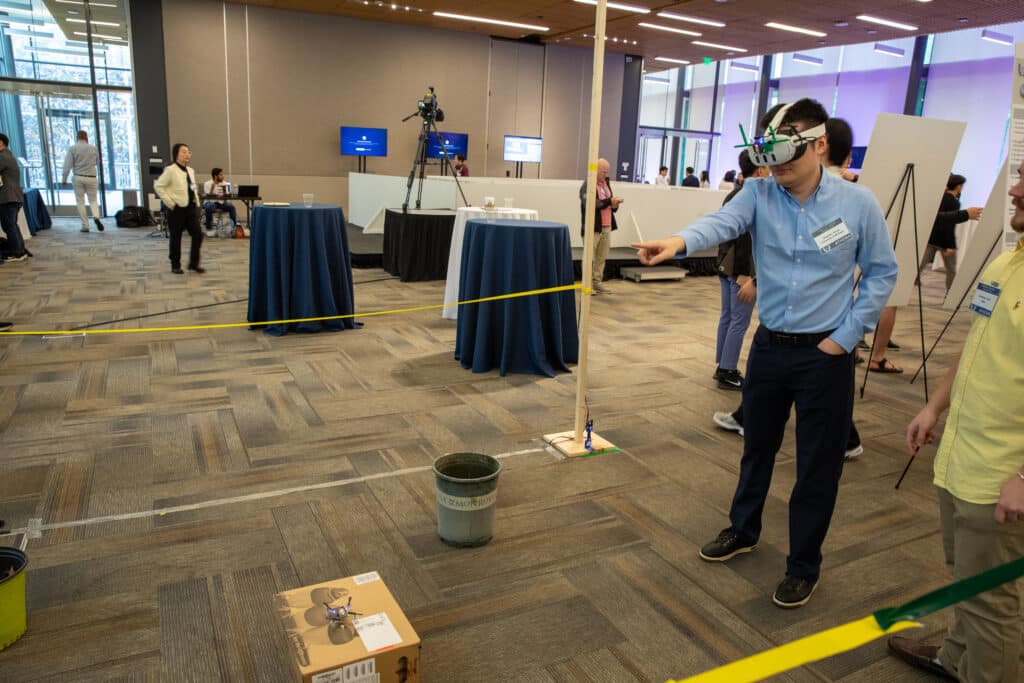
These scenes from past Athena “Demo Days” show how the center has swiftly progressed the distribution of data processing workloads across local edge devices and the development of more efficient on-device AI hardware. The center will focus its next five years on developing autonomous AI technologies and advancing long-lived, self-adaptive and self-evolving edge AI that enables unprecedented levels of interaction and coordination across edge systems, human users and the physical world.
Moving forward, Athena will build and grow on the successes of its first five years. Phase II will continue to see Athena technologies incorporated into invention disclosures, transferred to major industry partners and spun out into startups. In parallel, Phase II will open-source code, designs, benchmarks and testbeds; disseminate results through position papers and workshops; and deepen collaboration with industry and investors through a consortium that supports licensing, joint development and entrepreneurship.
Athena’s education and workforce development program will also continue to engage learners at all levels through cross-campus curricula, industry internships, graduate bootcamps, seminars and K-12 outreach co-designed with community partners. By strengthening cross-institutional collaboration, Athena will sustain an open research and education community that advances U.S. leadership in edge AI and informs national policy.
The technology pursued by Athena’s second phase is especially exciting. Its four research thrusts include: efficient, elastic platforms for next-generation AI workloads; algorithms and theory for autonomous edge AI; AI-driven design of multi-component edge systems that interact directly with the physical world; and use cases enabled by these systems. Specifically, its research will emphasize physical AI systems and integrations with emerging quantum computing capabilities for both the design of quantum systems and deploying quantum capabilities.
The NSF- and DHS-funded institute attracted visitors from industry and government to showcase Duke’s leadership in artificial intelligence and edge computing.
The Athena AI Institute brought together prominent stakeholders to further the global collaborations needed to scale edge AI.
Cookie Consent
This website uses cookies as well as similar tools and technologies to understand visitors' experiences. By continuing to use this website, you consent to Duke University's usage of cookies and similar technologies, in accordance with the Duke Privacy Statement.
Cookie Preferences
Manage your cookie preferences below:
Essential cookies enable basic functions and are necessary for the proper function of the website.
Name
Description
Duration
Cookie Preferences
This cookie is used to store the user's cookie consent preferences.
30 days
Google reCAPTCHA helps protect websites from spam and abuse by verifying user interactions through challenges.
Name
Description
Duration
_GRECAPTCHA
Google reCAPTCHA sets a necessary cookie (_GRECAPTCHA) when executed for the purpose of providing its risk analysis.
179 days
Google Tag Manager simplifies the management of marketing tags on your website without code changes.
Name
Description
Duration
td
Registers statistical data on users' behaviour on the website. Used for internal analytics by the website operator.